Explore the complete JavaScript ecosystem – languages, engines, runtimes, frameworks, libraries, tools, and modern platforms. Learn everything you need to know in this guide by teShaHch.com.
🌐 JavaScript Ecosystem: The Complete Guide
A beginner-friendly roadmap to JavaScript runtimes, frameworks, and tools.
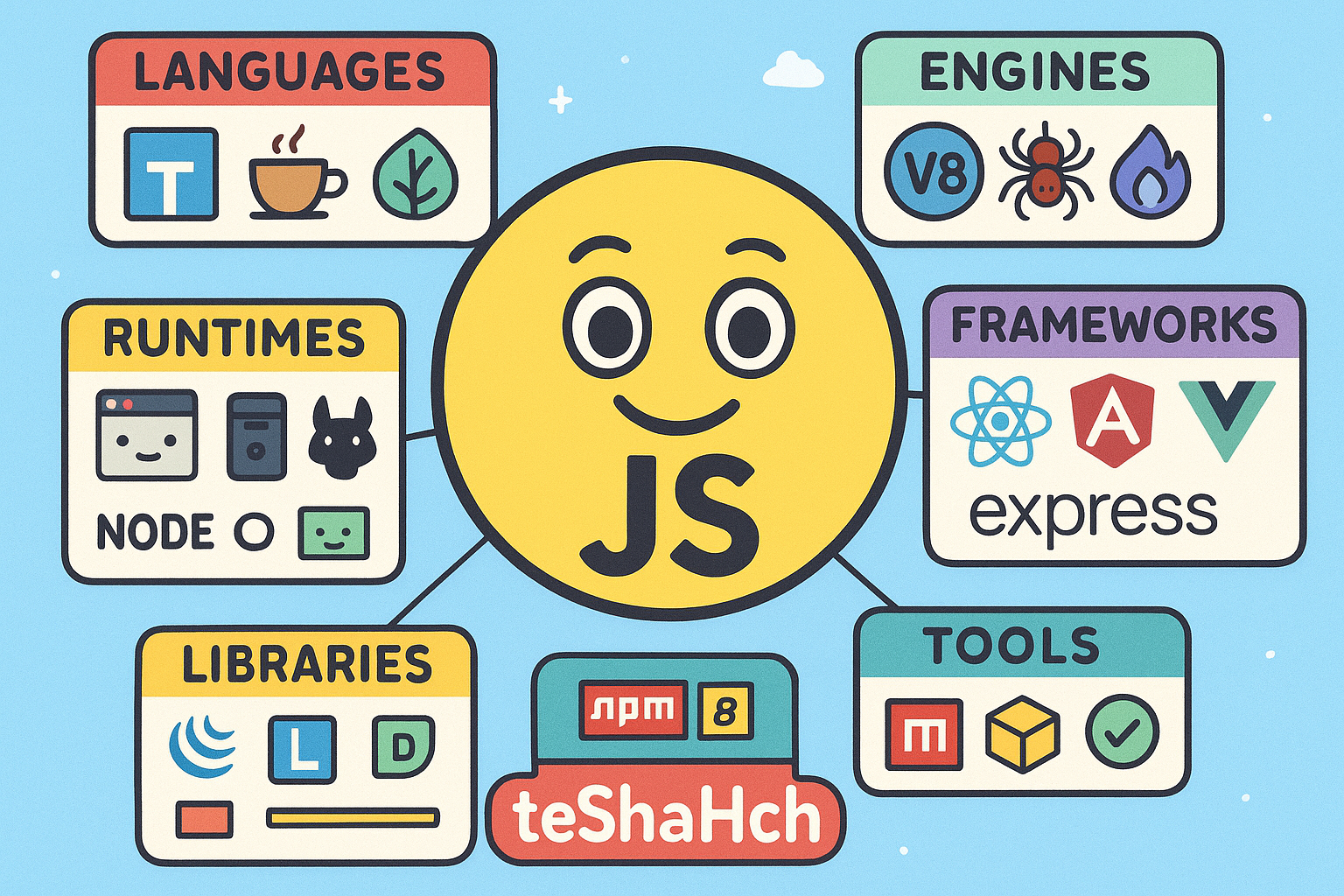
JavaScript is no longer “just a programming language.” It has grown into one of the largest ecosystems in technology, powering everything from web apps to mobile, desktop, and even server-side applications.
In this guide, we’ll break down the JavaScript ecosystem into clear categories, so you can understand every major piece without confusion.
Whether you are a beginner or an experienced developer, this article (by teShaHch.com) will give you a complete overview.
🔹 1. Languages & Supersets
At the core of the ecosystem is JavaScript (ECMAScript) itself. But many languages extend or compile down to JS:
- JavaScript (ES6+) – the standard language.
- TypeScript – adds static typing, making large projects safer.
- CoffeeScript – simpler syntax that compiles to JS.
- Elm – functional language that compiles to JS.
🔹 2. JavaScript Engines
Engines are responsible for executing JS code by converting it into machine code:
- V8 – used in Chrome & Node.js.
- SpiderMonkey – used in Firefox.
- JavaScriptCore (Nitro) – used in Safari.
- Chakra – used in older Microsoft Edge.
🔹 3. Runtime Environments
Runtimes provide the environment where JavaScript code runs:
- Web Browsers (Chrome, Firefox, Safari, Edge).
- Node.js – for running JS on the server.
- Deno – a modern, secure runtime.
- Bun – a blazing fast new runtime.
🔹 4. Module Systems
Code organization is critical, and different standards exist:
- CommonJS – used in Node.js (
require). - ES Modules – modern standard (
import/export). - AMD/UMD – older systems for browser compatibility.
🔹 5. Libraries
Libraries provide pre-written functions that you can call in your projects:
- jQuery – simplifies DOM manipulation.
- Lodash / Underscore.js – utility functions for arrays, objects, etc.
- Axios – HTTP client.
- Moment.js / Day.js – work with dates & time.
- Chart.js / D3.js – data visualization.
🔹 6. Frameworks
Frameworks provide structure and “rules” for building applications.
Frontend Frameworks:
- React.js (technically a library, but widely treated as a framework).
- Angular.
- Vue.js.
- Svelte.
- Next.js / Nuxt.js – server-side rendering (SSR).
Backend Frameworks:
- Express.js (most popular with Node.js).
- NestJS.
- Meteor.js.
- AdonisJS.
🔹 7. Package Managers
Tools for installing and managing dependencies:
- npm – default package manager.
- yarn.
- pnpm.
🔹 8. Bundlers & Build Tools
These optimize and bundle code for performance:
- Webpack.
- Parcel.
- Vite.
- Rollup.
- Gulp.
- Grunt.
🔹 9. Compilers / Transpilers
Convert modern JavaScript into code that runs everywhere:
- Babel – ES6+ → ES5.
- TypeScript Compiler (tsc) – compiles TypeScript into JS.
🔹 10. APIs
APIs provide built-in functionality for the browser or runtime:
- DOM API – manipulate HTML/CSS.
- Fetch API / XMLHttpRequest – make HTTP requests.
- Web Storage API – LocalStorage, SessionStorage.
- WebSockets API – real-time communication.
- Canvas API – graphics & drawing.
- WebRTC – peer-to-peer video/audio.
🔹 11. Asynchronous Programming
JavaScript is single-threaded, but async features make it powerful:
- Callbacks.
- Promises.
- async/await.
- Event Loop.
- Microtasks & Macrotasks.
🔹 12. Testing Frameworks
Testing ensures software reliability:
- Jest – popular for React/Node.
- Mocha + Chai – flexible testing.
- Cypress – end-to-end testing.
- Playwright / Puppeteer – browser automation & testing.
🔹 13. Linting & Formatting
Keep your code consistent and bug-free:
- ESLint – identifies errors.
- Prettier – formats code.
🔹 14. Modern Platforms
JavaScript now powers more than the web:
- Electron – desktop apps (VS Code, Slack).
- React Native – mobile apps.
- Expo – framework on top of React Native.
- Ionic / Capacitor – hybrid apps.
✅
The JavaScript ecosystem includes:
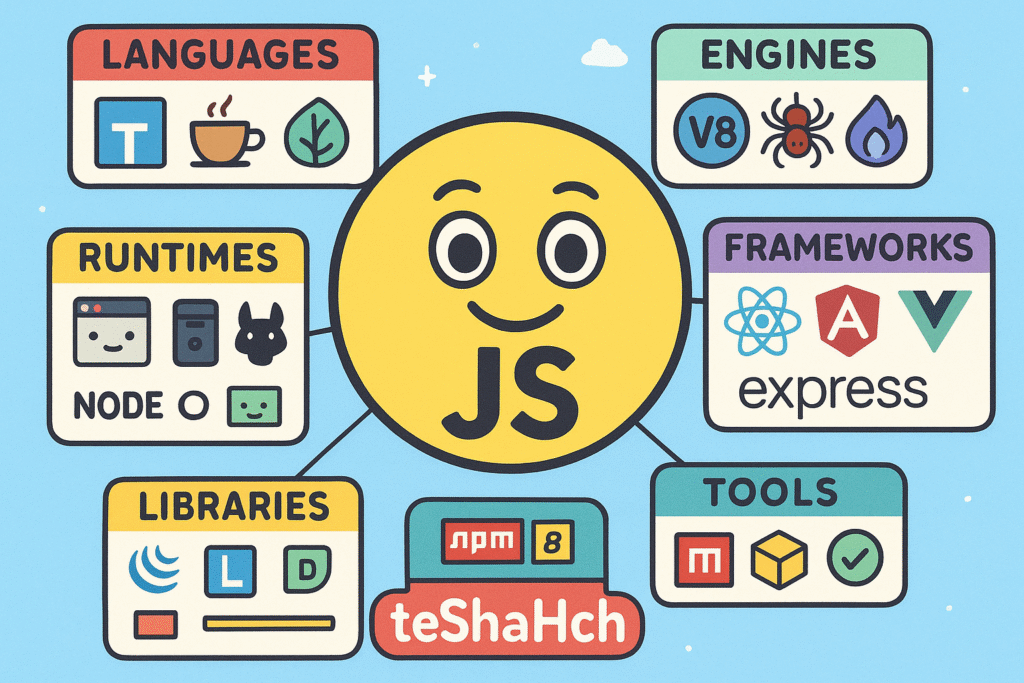
- Languages (JS, TS, Elm, CoffeeScript).
- Engines & Runtimes (V8, Node.js, Deno, Bun).
- Libraries & Frameworks (React, Angular, Express).
- Tools (npm, Babel, Webpack, ESLint, Jest).
- APIs & Async Model.
- Modern Platforms (Electron, React Native).
This ecosystem makes JavaScript one of the most versatile programming environments in the world.
👉 At teShaHch.com, we help developers and businesses make the most of this ecosystem, building scalable, modern, and efficient tech solutions.