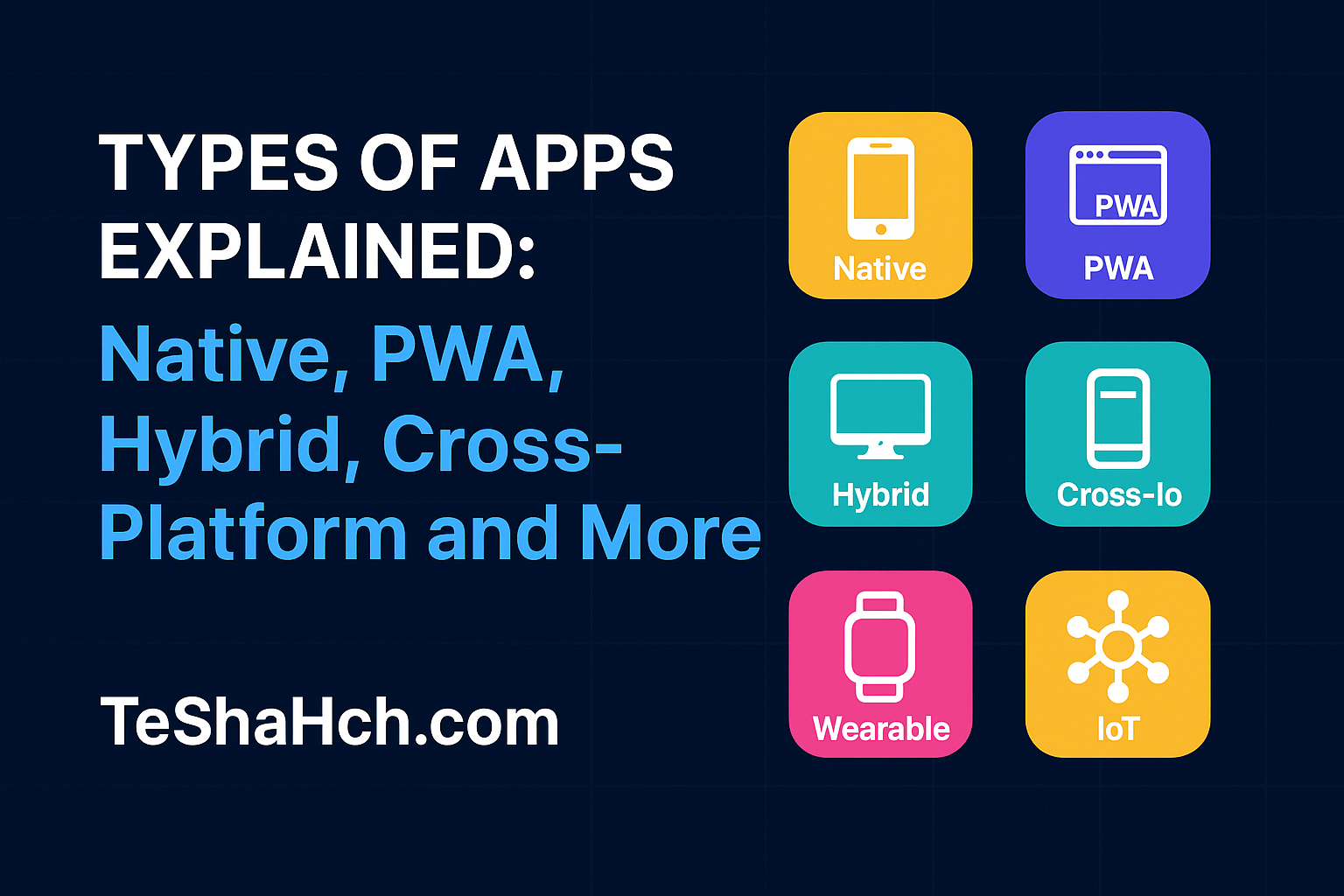
Discover the different types of apps — Native, Progressive Web Apps (PWA), Hybrid, Cross-Platform, AR/VR, IoT and more. Complete guide.
🌍
In today’s digital-first world, apps are everywhere – from mobile phones and desktops to smartwatches and even cars. But not all apps are built the same way. Understanding the different types of apps can help businesses, developers, and tech enthusiasts choose the right solution for their needs.
In this article, we’ll explore the major app models with examples, key features, and differences.
📱 1. Native Apps
Native apps are developed specifically for one platform – Android or iOS.
- Pros: Best performance, full hardware access, seamless user experience.
- Cons: Higher cost and separate codebase for each platform.
- Examples: WhatsApp, Instagram.
🌐 2. Progressive Web Apps (PWA)
PWAs are a mix of websites and apps. They run in browsers but can be installed on your device like an app.
- Pros: One code for all devices, cheaper to develop, offline support.
- Cons: Limited hardware access, slightly slower performance.
- Examples: Twitter Lite, Flipkart Lite.
⚡ 3. Hybrid Apps
Hybrid apps are built using web technologies (HTML, CSS, JavaScript) but wrapped in a native shell.
- Pros: One code for multiple platforms.
- Cons: Not as fast as native apps.
- Frameworks: Ionic, Apache Cordova.
🔀 4. Cross-Platform Apps
Cross-platform frameworks like Flutter or React Native allow developers to write one codebase and deploy on both Android and iOS.
- Pros: Near-native performance, faster development.
- Cons: May not access all device features as smoothly as native apps.
- Examples: Facebook, Alibaba, Airbnb.
💻 5. Desktop Apps (Native & Web)
- Native Desktop Apps: OS-specific apps for Windows, macOS, Linux. (Example: Photoshop, MS Office)
- Web Desktop Apps: Run inside a browser but offer desktop-like experience. (Example: Gmail, Google Docs)
⌚ 6. Wearable Apps
Apps designed for smartwatches and fitness bands.
- Examples: Google Fit, Apple Fitness.
🔌 7. IoT Apps
Internet of Things (IoT) apps control smart devices like lights, fridges, or cars.
- Examples: Alexa, Google Home.
⚡ 8. Instant Apps (Android)
Lightweight apps that run without installation.
- Examples: Flipkart Instant.
🎮 9. Game Apps
Games are often treated as a separate category, developed with engines like Unity or Unreal Engine.
- Examples: PUBG Mobile, Candy Crush.
🏢 10. Enterprise Apps
Internal apps built for organizations, not for public app stores.
- Examples: HR systems, CRM apps.
🕶️ 11. AR / VR / MR Apps
- AR Apps: Blend digital content with the real world (Pokémon Go).
- VR Apps: Fully immersive virtual environments (Google Earth VR).
- MR Apps: Mix of AR + VR (Microsoft HoloLens).
💳 12. Super Apps & Mini Apps
- Super Apps: One app with multiple services (WeChat, Paytm).
- Mini Apps: Small apps inside a super app (WeChat Mini Programs).
☁️ 13. Cloud Apps
Apps that run in the cloud, reducing the need for local storage and processing.
- Examples: Google Drive, Stadia (Cloud Gaming).
⚙️ 14. Embedded Apps
Apps built directly into devices like Smart TVs, Cars, or Smart Refrigerators.
📊 Comparison Table
| App Type | Platform | Key Benefit | Example |
|---|---|---|---|
| Native | Mobile | Best performance | |
| PWA | Web + Mobile | Low cost, cross-device | Twitter Lite |
| Hybrid | Mobile | Web inside native shell | Uber (early) |
| Cross-Platform | Mobile | One code for all | |
| Desktop Native | PC | OS-specific power | Photoshop |
| Desktop Web | Web | Browser-based | Gmail |
| Wearable | Device | Smartwatch use | Apple Fitness |
| IoT | Device | Smart gadgets | Alexa |
| Instant App | Mobile (Android) | No install needed | Flipkart Instant |
| Game App | Mobile + PC | Entertainment | PUBG Mobile |
| Enterprise | Mobile + Web | Business internal | CRM Tools |
| AR / VR / MR | Mobile + Device | Immersive experience | Pokémon Go |
| Super / Mini Apps | Mobile | Multi-service ecosystem | |
| Cloud Apps | Web + Mobile | Runs on cloud | Google Drive |
| Embedded Apps | Device | Pre-installed | Smart TV YouTube |
🚀
From Native Apps with top performance to PWAs that bring cost efficiency, from AR/VR for immersive experiences to IoT controlling smart homes – today’s app ecosystem is diverse and rapidly evolving.
If you’re building the next generation of apps, the right choice depends on your audience, budget, and features.
👉 At teShaHch.com, we help businesses design and build apps that are future-ready. We deliver with innovation and international quality.