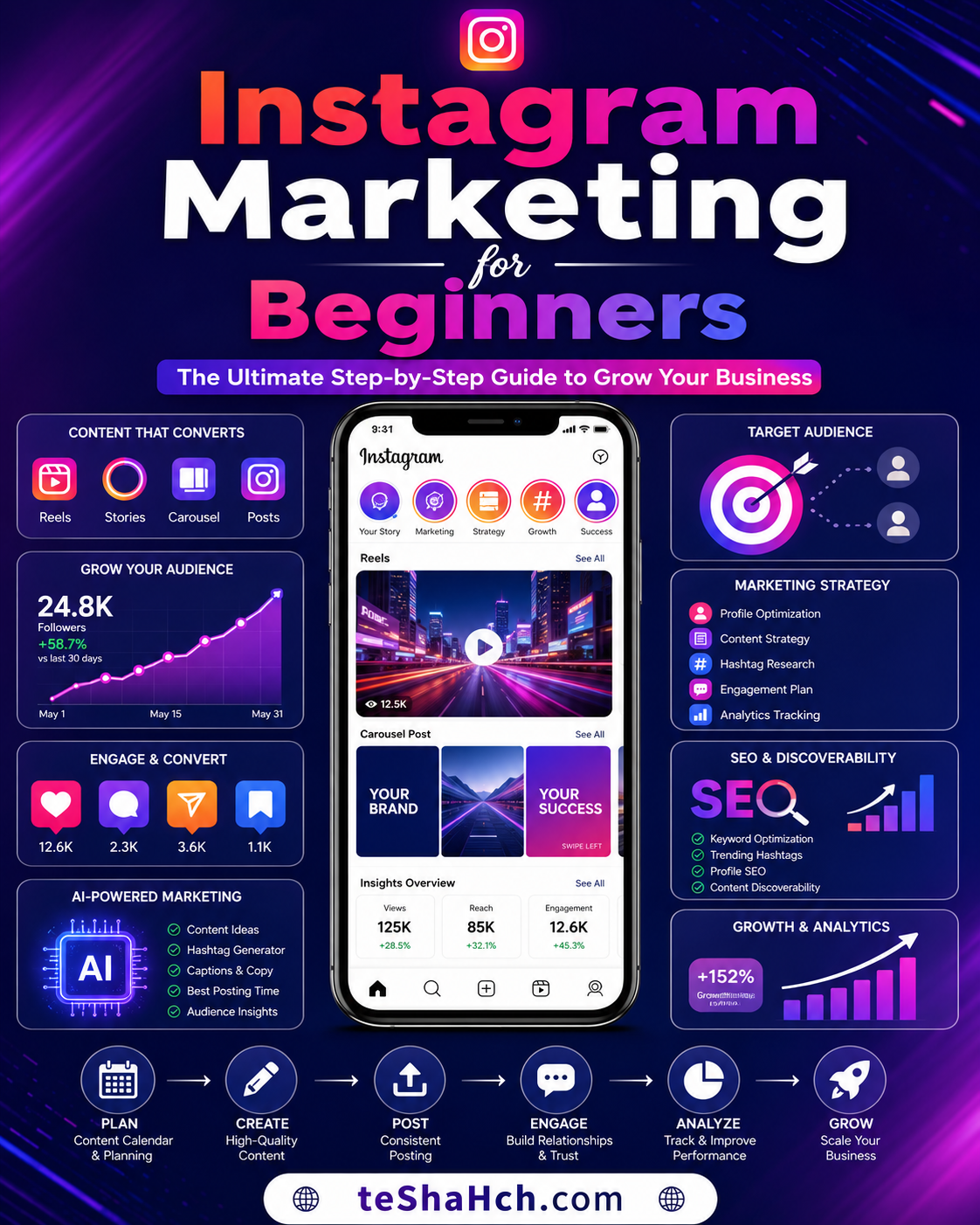
Learn Instagram marketing from scratch with this complete beginner’s guide. Discover how to grow your audience, increase engagement, generate leads, and turn Instagram into a powerful marketing channel for your business.
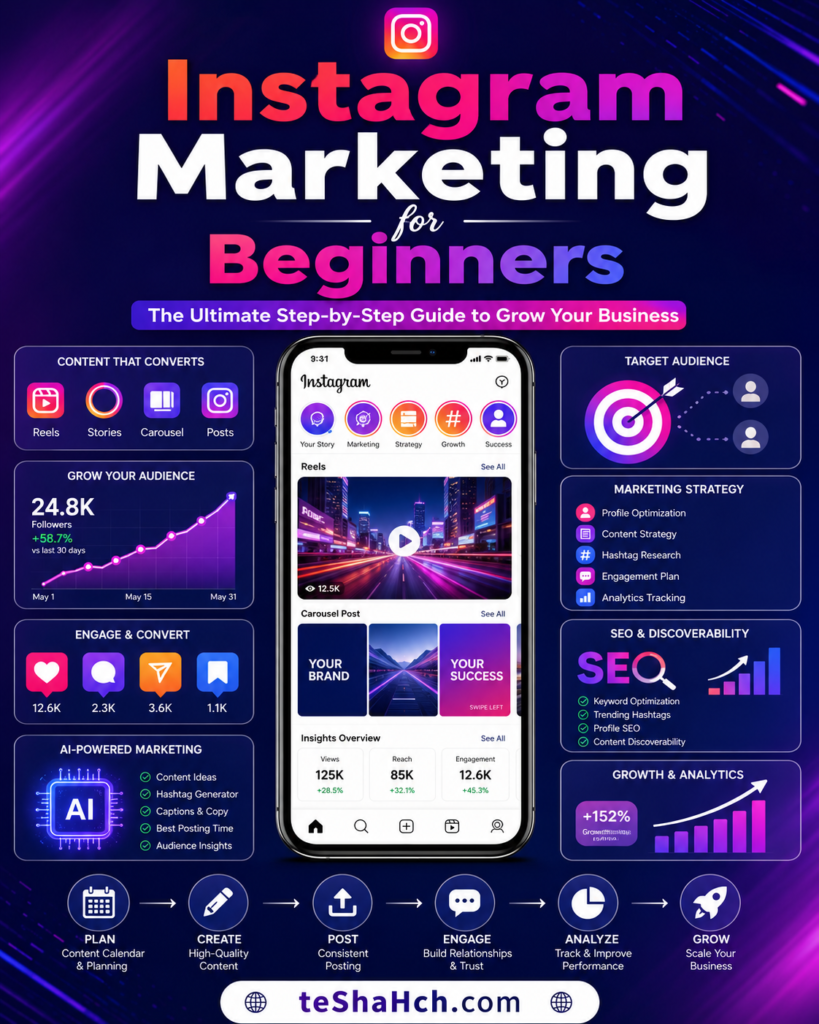
Instagram Marketing for Beginners: The Ultimate Guide to Grow Your Business, Brand & Sales
Imagine opening a new shop in the middle of a crowded city.
Thousands of people walk past your shop every day.
Some stop to look.
Some enter.
Some ask questions.
Some become customers.
Instagram works in a very similar way.
Instead of people walking down a street, millions of users scroll through Instagram every minute.
If your business appears in front of the right audience with valuable content, those users can become followers, leads, and eventually paying customers.
This is exactly what Instagram marketing is designed to achieve.
Whether you own a local business, an online store, a coaching center, a software company, a restaurant, or a personal brand, Instagram has become one of the most effective marketing platforms available today.
The best part?
You don’t need millions of followers to get results.
A well-planned Instagram strategy with only a few thousand engaged followers often performs better than an account with hundreds of thousands of inactive followers.
That is why businesses of every size—from startups to global brands—invest heavily in Instagram marketing.
In this ultimate guide, you’ll learn everything you need to know to start Instagram marketing the right way.
What is Instagram Marketing?
Instagram marketing is the process of using Instagram strategically to promote a business, brand, product, or service.
Its objectives usually include:
- Increasing brand awareness
- Building trust
- Growing an engaged audience
- Driving website traffic
- Generating qualified leads
- Increasing sales
- Building long-term customer relationships
Unlike traditional advertising, Instagram marketing focuses on building meaningful interactions through valuable content rather than constantly promoting products.
Modern Instagram marketing combines creativity with data.
Successful marketers analyze audience behavior, engagement patterns, watch time, content performance, and customer interests to improve results continuously.
Simply posting attractive images is no longer enough.
Today’s Instagram marketing involves:
- Content strategy
- Audience research
- Brand positioning
- Search optimization
- Community management
- Analytics
- Lead generation
- Conversion optimization
Why Instagram Marketing Has Become So Important
Consumer behavior has changed dramatically over the past decade.
Before purchasing a product or hiring a service, many people now research businesses on social media.
A potential customer may check:
- Your Instagram profile
- Customer reviews
- Your recent content
- Brand consistency
- Engagement quality
- Educational posts
- Testimonials
This means your Instagram profile often acts as your first impression.
If your profile looks inactive, unprofessional, or confusing, many potential customers leave before contacting you.
On the other hand, a professional Instagram presence builds trust even before the first conversation.
For service-based businesses like teShaHch.com, Instagram can become much more than a branding platform.
It can become a consistent source of qualified leads.
Why Every Beginner Should Learn Instagram Marketing
Many people believe Instagram marketing is only useful for influencers.
That is no longer true.
Instagram marketing benefits:
Small Business Owners
Reach local customers without spending huge advertising budgets.
Freelancers
Build authority and attract clients through educational content.
Startups
Create brand awareness before investing heavily in paid advertising.
Coaches and Consultants
Share expertise and generate high-quality leads.
E-commerce Businesses
Showcase products using Reels, Stories, and carousel posts.
Educational Institutions
Promote courses, events, workshops, and student success stories.
Personal Brands
Build credibility and grow an engaged audience.
Is Instagram Marketing Free?
This is one of the most frequently asked questions.
The answer is:
Yes—and no.
Instagram offers two marketing approaches.
Organic Instagram Marketing
Organic marketing means growing naturally without paying for advertisements.
Examples include:
- Posting Reels
- Publishing educational carousel posts
- Sharing Stories
- Engaging with followers
- Building a community
- Optimizing your profile
Advantages:
- No advertising cost
- Builds long-term trust
- Sustainable growth
- Better customer relationships
Disadvantages:
- Takes time
- Requires consistency
- Results are gradual
Paid Instagram Marketing
Paid marketing uses Instagram Ads to reach targeted audiences.
Businesses can promote:
- Products
- Services
- Events
- Websites
- Lead forms
Advantages:
- Faster reach
- Highly targeted campaigns
- Quick lead generation
Disadvantages:
- Requires budget
- Needs campaign optimization
- Poor targeting can waste money
The most successful businesses combine organic and paid marketing rather than relying on only one approach.
How Instagram Actually Works
Many beginners believe Instagram simply shows posts in chronological order.
That hasn’t been true for years.
Instagram uses sophisticated AI systems to determine which content each user is most likely to enjoy.
Every time you publish content, Instagram analyzes multiple signals before deciding how widely to distribute it.
These signals include:
- Watch time
- Saves
- Shares
- Comments
- Likes
- Profile visits
- Audience interaction history
- Content relevance
- Viewing behavior
If these signals are positive, Instagram gradually increases your reach.
This is why two similar posts can receive completely different results.
The difference often lies in audience response rather than luck.
Understanding the Instagram Algorithm (Beginner-Friendly)
Many beginners are afraid of the word “algorithm.”
In reality, the algorithm has one simple job:
Show people the content they are most likely to enjoy.
Instagram wants users to stay on the platform for as long as possible.
If your content helps achieve that goal, Instagram rewards it with greater visibility.
Imagine two Reels.
Reel A
- People watch only 3 seconds.
- Most users scroll immediately.
Instagram concludes:
“This content isn’t interesting.”
Distribution slows.
Reel B
- People watch until the end.
- Many replay it.
- Users save it.
- They share it with friends.
Instagram concludes:
“This content creates value.”
Reach expands significantly.
This explains why creating engaging content matters more than simply posting frequently.
Organic Growth vs Viral Growth
Many beginners dream of going viral overnight.
While viral success is exciting, sustainable growth comes from consistency.
Organic growth focuses on:
- Helpful content
- Audience trust
- Consistent posting
- Continuous improvement
Viral growth often happens when these fundamentals are already in place.
Businesses should prioritize building a loyal audience instead of chasing temporary viral moments.
Why Businesses Fail on Instagram
Thousands of businesses create Instagram accounts every year.
Many stop posting after just a few months.
Common reasons include:
- No strategy
- Inconsistent posting
- Low-quality content
- Over-promotion
- Lack of patience
- Ignoring analytics
- No understanding of audience needs
Instagram rewards businesses that consistently provide value.
Those expecting instant sales without building trust often become frustrated.
The Mindset Every Beginner Should Have
Instead of asking:
“How can I get more followers?”
Ask:
“How can I become more valuable to my audience?”
This simple shift changes everything.
Followers come because of value.
Engagement comes because of relevance.
Sales come because of trust.
And trust is built through consistent, helpful content over time.
Step 1: Create an Instagram Business Account
Before you think about getting followers, creating Reels, or running ads, you need a professional business account.
Many beginners start with a personal account because it’s quick and easy.
However, if your goal is to grow a business, generate leads, or attract customers, a Business Account is the better choice.
Think of it this way:
A personal account is like a casual conversation with friends.
A business account is like opening a professional showroom where customers can learn about your brand, contact you, and decide whether to buy from you.
Why Choose an Instagram Business Account?
Instagram provides several professional features that are unavailable or limited on personal accounts.
With a Business Account, you can:
- Access Instagram Insights
- Add contact buttons
- Display your business category
- Run Instagram Ads
- Track audience demographics
- Measure engagement and reach
- Schedule content using professional tools
- Connect your Facebook Page
- Build trust with potential customers
For a company like teShaHch.com, these features are essential because the goal is not just gaining followers—it is generating inquiries and clients.
Personal Account vs Business Account
| Feature | Personal | Business |
|---|---|---|
| Professional Analytics | ❌ | ✅ |
| Contact Button | ❌ | ✅ |
| Business Category | ❌ | ✅ |
| Instagram Ads | ❌ | ✅ |
| Audience Insights | ❌ | ✅ |
| Lead Generation | Limited | Excellent |
| Brand Credibility | Medium | High |
Recommendation:
If you represent a business, agency, startup, freelancer, consultant, coach, school, or online store, use a Business Account.
Step 2: Optimize Your Instagram Profile
Imagine someone visits your Instagram profile for the first time.
They usually decide within 5–10 seconds whether to follow you or leave.
This means your profile acts as your digital first impression.
A well-optimized profile can increase:
- Followers
- Profile visits
- Website clicks
- Direct Messages
- Lead generation
The Five-Second Profile Test
Ask yourself:
If a stranger visits your profile for only five seconds, can they answer these questions?
✅ Who are you?
✅ What do you do?
✅ Who do you help?
✅ Why should they follow you?
✅ How can they contact you?
If the answer to any of these is “No,” your profile needs improvement.
Choosing the Right Username
Your username should be:
- Easy to read
- Easy to remember
- Brand-focused
- Search-friendly
Good examples:
- @teShahch
- @teShahchOfficial
- @teShahchMarketing
Avoid usernames like:
- @tsh_8946
- @marketing123xyz
- @abc_company_987
Simple names are easier to search and remember.
Optimizing the Name Field
Many beginners ignore the Name field.
This is a mistake.
Instagram also uses this field for search.
Instead of only writing:
teShaHch
consider:
teShaHch | Digital Marketing Agency
or
teShaHch | Website & Digital Marketing
This gives Instagram more context about your business.
Writing a Powerful Bio
Your bio should answer four simple questions:
1. What do you do?
Example:
Helping businesses grow online through Digital Marketing.
2. Who do you help?
Example:
Small Businesses • Startups • Schools • Local Brands
3. Why should people trust you?
Example:
Website Development | SEO | Social Media Marketing
4. What should visitors do next?
Example:
👇 Book Your Free Consultation
Example Professional Bio
🚀 Grow Your Business Online
🌐 Website Development
📈 SEO & Digital Marketing
🎯 Social Media Growth
👇 Get Your Free Consultation
🌍 teShaHch.com
This is simple, professional, and conversion-focused.
Choosing the Right Profile Picture
For businesses, consistency is important.
Use:
- Company logo
- High-quality image
- Clear background
- Square format
- High resolution
Avoid:
❌ Blurry logos
❌ Random graphics
❌ Small unreadable text
Your logo should remain recognizable even on a smartphone screen.
Add Contact Information
Instagram allows businesses to add:
- Phone Number
- Business Address
- WhatsApp (where supported)
These options make it easier for potential customers to contact you directly.
Add a Website Link
Never leave the website field empty.
This is one of the highest-converting elements on your profile.
For teShaHch.com, your website becomes the primary destination where visitors can:
- Explore services
- Read blogs
- Request quotations
- Contact your team
A complete profile creates a seamless journey from Instagram visitor to potential customer.
Step 3: Understand Your Target Audience
Many beginners make this mistake:
They create content for everyone.
The result?
They attract no one.
Successful Instagram marketing starts with understanding exactly who you want to reach.
Build Your Ideal Customer Profile
Instead of saying:
“My audience is everyone.”
Be specific.
For example, if you’re promoting teShaHch.com, your ideal audience could include:
- Small business owners
- Local shop owners
- School administrators
- Startup founders
- Coaches and consultants
- Freelancers
- E-commerce sellers
These people are actively looking for ways to grow online.
Understand Their Problems
People don’t engage with content because it’s beautiful.
They engage because it solves a problem.
Ask questions like:
- Why are they on Instagram?
- What challenges do they face?
- What goals do they have?
- What information are they searching for?
For example, many small business owners struggle with:
- Low engagement
- No website traffic
- Few customer inquiries
- Poor brand visibility
- Lack of digital marketing knowledge
Every piece of content should solve at least one of these problems.
Step 4: Define Your Content Goals
Before posting anything, decide why you’re posting.
Different goals require different types of content.
Examples:
Goal: Brand Awareness
Create:
- Educational posts
- Tips
- Infographics
- Industry insights
Goal: Engagement
Create:
- Polls
- Questions
- Behind-the-scenes content
- Interactive Stories
Goal: Lead Generation
Create:
- Case studies
- Client success stories
- Service explainers
- Free consultation offers
Goal: Sales
Create:
- Product demonstrations
- Testimonials
- Before-and-after results
- Limited-time offers
The 80/20 Content Rule
One of the biggest mistakes beginners make is trying to sell in every post.
People follow businesses because they want value—not constant advertisements.
A practical guideline is:
- 80% Value-Based Content
- Tips
- Guides
- Tutorials
- FAQs
- Industry updates
- Educational posts
- 20% Promotional Content
- Services
- Offers
- Testimonials
- Success stories
- Consultation invitations
This balance helps build trust while still generating business opportunities.
Step 5: Understand the Four Core Content Types
Many beginners believe they should post only product photos.
This is one of the biggest reasons businesses fail on Instagram.
Successful brands don’t just sell.
They educate.
They entertain.
They inspire.
They build trust.
Think of Instagram as a relationship-building platform before it becomes a selling platform.
Content Type 1: Educational Content
Educational content establishes authority.
It answers questions, solves problems, and teaches your audience something useful.
Examples:
- How-to guides
- Step-by-step tutorials
- Marketing tips
- SEO tips
- Website optimization tips
- Instagram algorithm updates
- Business growth advice
Why It Works
People save educational posts.
Saved posts are one of Instagram’s strongest positive ranking signals.
Educational content also builds trust because your audience sees you as an expert rather than just a seller.
Content Type 2: Inspirational Content
People don’t always visit Instagram to buy.
Sometimes they want motivation.
Examples:
- Success stories
- Client achievements
- Before-and-after transformations
- Startup journeys
- Business milestones
For teShaHch.com, you could share:
- Website redesign success stories
- SEO ranking improvements
- Traffic growth case studies
- Social media growth examples
These posts inspire potential customers and demonstrate real results.
Content Type 3: Entertainment Content
Instagram is still a social platform.
Not every post needs to be serious.
Examples include:
- Trending Reels
- Light business humor
- Behind-the-scenes moments
- Team celebrations
- Office culture
- Relatable marketing situations
Entertainment increases shares and helps humanize your brand.
Content Type 4: Promotional Content
This is where you talk about your services.
Examples:
- Website Development
- SEO Services
- Social Media Marketing
- Digital Marketing Solutions
- App Development
However, avoid making every post promotional.
Promotion works best after you’ve already built trust through valuable content.
The Perfect Content Mix
A healthy Instagram strategy balances different content types.
A practical distribution could look like this:
- 40% Educational
- 25% Inspirational
- 20% Entertainment
- 15% Promotional
This keeps your audience engaged while naturally introducing your services.
Step 6: Build Content Pillars
One common mistake beginners make is posting random topics.
One day they post about SEO.
The next day about photography.
Then a motivational quote.
Then a product offer.
This confuses both your audience and Instagram’s algorithm.
Instead, create Content Pillars—core themes that your audience will associate with your brand.
Example Content Pillars for teShaHch.com
Pillar 1: Website Development
Topics:
- Website design
- Website speed
- WordPress
- Landing pages
- Website maintenance
Pillar 2: SEO
Topics:
- On-page SEO
- Technical SEO
- Local SEO
- Keyword research
- Google ranking tips
Pillar 3: Instagram Marketing
Topics:
- Reels
- Engagement
- Reach
- Hashtags
- Algorithm
- Content strategy
Pillar 4: Digital Marketing
Topics:
- Lead generation
- Email marketing
- Branding
- Conversion optimization
- Marketing strategy
Pillar 5: Client Success
Topics:
- Case studies
- Testimonials
- Project showcases
- Before-and-after results
These pillars keep your content focused and help Instagram understand your niche.
Step 7: Reels vs Posts vs Stories vs Carousels
Each content format serves a different purpose.
Instagram Reels
Best for:
- Reach
- Discoverability
- New followers
Advantages:
- High organic reach
- Explore page visibility
- Viral potential
Ideal frequency:
4–5 Reels per week.
Feed Posts
Best for:
- Branding
- Announcements
- Product showcases
Advantages:
- Professional appearance
- Evergreen content
Ideal frequency:
2–3 posts per week.
Carousel Posts
Best for:
- Tutorials
- Checklists
- Guides
- Educational content
Advantages:
- High save rate
- Longer viewing time
- Better engagement
Ideal frequency:
1–2 carousels per week.
Stories
Best for:
- Daily engagement
- Polls
- Q&A
- Behind-the-scenes content
- Limited-time offers
Stories keep your brand top-of-mind and encourage regular interaction.
Aim to post Stories every day.
Which Content Type Should Beginners Prioritize?
If you’re just starting out, focus on this order:
- Reels
- Carousel Posts
- Stories
- Feed Posts
Reels attract new audiences.
Carousels build authority.
Stories strengthen relationships.
Feed posts reinforce your brand identity.
Step 8: How Often Should You Post?
One of the most common questions is:
“Should I post every day?”
Not necessarily.
Consistency matters more than frequency.
A realistic schedule for beginners:
- 4 Reels per week
- 2 Carousel posts per week
- Daily Stories
- 1 Brand-focused feed post per week
This schedule is sustainable and provides a healthy mix of content.
Step 9: The Beginner’s Weekly Content Calendar
A simple content plan prevents creative burnout.
Monday
Educational Reel
Example:
“3 Instagram Mistakes Small Businesses Make”
Tuesday
Story Poll
Example:
“Which marketing challenge do you face most?”
Wednesday
Carousel Guide
Example:
“5 SEO Tips for Beginners”
Thursday
Behind-the-Scenes Story
Show your team, workspace, or current project.
Friday
Client Success Story
Highlight measurable results achieved for a customer.
Saturday
Quick Tips Reel
Share a practical marketing tip in under 30 seconds.
Sunday
Soft Promotional Post
Invite followers to book a consultation or explore your services.
Step 10: Best Time to Post
There is no single “magic” posting time.
The best time depends on your audience’s behavior.
However, for many business accounts, these time ranges often perform well:
- Morning: 7:00 AM – 9:00 AM
- Lunch: 12:00 PM – 2:00 PM
- Evening: 6:00 PM – 9:00 PM
Start with these windows, then review your Instagram Insights to identify when your own audience is most active.
Step 11: A Professional Posting Workflow
Don’t publish content at the last minute.
Follow a structured process:
- Research audience problems.
- Choose a content pillar.
- Write a strong hook.
- Create high-quality visuals.
- Add a keyword-rich caption.
- Include a clear call to action.
- Publish at a consistent time.
- Respond to comments and messages promptly.
- Review performance after a few days.
- Improve future content based on what worked.
This workflow helps you create content strategically instead of randomly.
Common Content Planning Mistakes
Avoid these beginner mistakes:
- Posting only promotional content
- Ignoring Reels
- Publishing without a clear goal
- Inconsistent posting schedule
- Copying competitors without adding value
- Not replying to comments or messages
- Failing to review analytics
Successful Instagram marketing is built on consistency, relevance, and continuous improvement—not shortcuts.
Instagram SEO for Beginners
A few years ago, most people believed Instagram growth depended mainly on hashtags and luck.
That is no longer true.
Instagram has evolved into an AI-powered discovery platform that analyzes your content much like a search engine.
Today, Instagram tries to understand:
- What your content is about
- Who should see it
- Which users are likely to engage with it
- Whether it deserves wider distribution
This process is known as Instagram SEO (Search Engine Optimization).
If your content is optimized properly, Instagram can recommend it to more people—even if they don’t follow your account.
What Is Instagram SEO?
Instagram SEO is the process of optimizing your profile and content so Instagram can better understand, categorize, and recommend it.
Unlike traditional SEO for Google, Instagram SEO focuses on:
- Profile optimization
- Keyword relevance
- Captions
- On-screen text
- Audience engagement
- Watch time
- Saves
- Shares
- Content relevance
The goal is simple:
Help Instagram understand exactly what your content is about.
Why Instagram SEO Matters
Imagine you publish two Reels about website design.
Reel A
Caption:
New video 🔥
Reel B
Caption:
Learn five website design mistakes that reduce customer trust and conversions.
Which one gives Instagram more context?
Clearly, Reel B.
Instagram can identify keywords such as:
- website design
- customer trust
- conversions
This helps the platform recommend your content to users interested in those topics.
How Instagram Understands Your Content
Instagram no longer relies on hashtags alone.
It uses multiple AI systems to understand every piece of content.
1. Caption Analysis
Instagram scans captions to identify the topic of your post.
For example:
“Learn Instagram marketing strategies for small businesses.”
Instagram understands that your content relates to:
- Instagram Marketing
- Small Business
- Social Media
This improves discoverability.
2. On-Screen Text Recognition
Instagram can read text displayed inside images and videos.
If your Reel contains:
“Instagram SEO Tips”
that text becomes another signal helping Instagram categorize your content.
This is why clean, readable text overlays are important.
3. Audio Recognition
If you speak clearly in your Reel:
“Today we’ll learn Instagram marketing…”
Instagram can analyze spoken words and use them as additional context.
Voiceovers now contribute to discoverability.
4. Visual Recognition
Instagram AI also recognizes visual elements.
Examples:
- Food
- Laptops
- Offices
- Mobile phones
- Clothing
- Restaurants
- Cars
For teShaHch.com, showing laptops, analytics dashboards, websites, and marketing visuals helps reinforce your niche.
Keywords vs Hashtags
Many beginners ask:
“Should I focus on keywords or hashtags?”
The answer is:
Both matter—but not equally.
| Factor | Importance |
|---|---|
| Keywords | ⭐⭐⭐⭐⭐ |
| Watch Time | ⭐⭐⭐⭐⭐ |
| Saves | ⭐⭐⭐⭐⭐ |
| Shares | ⭐⭐⭐⭐⭐ |
| Hashtags | ⭐⭐⭐☆☆ |
Hashtags still provide context, but Instagram now relies much more on keywords and user behavior.
How to Choose the Right Keywords
Don’t guess.
Think about what your potential customers are searching for.
For example, if you offer digital marketing services, relevant keywords might include:
- Instagram Marketing
- Digital Marketing
- SEO
- Social Media Strategy
- Website Development
- Lead Generation
- Content Marketing
Use these naturally within your captions and on-screen text.
Avoid forcing keywords where they don’t fit.
Writing SEO-Friendly Captions
Captions should do more than describe your post.
They should provide context.
Poor Example
New post! 🚀
Instagram learns almost nothing.
Better Example
Discover how Instagram marketing can help small businesses increase engagement, generate qualified leads, and build a stronger online presence.
This version clearly explains the topic and includes relevant keywords.
Optimizing Your Profile for Search
Your Instagram profile is also searchable.
Pay attention to:
Username
Keep it simple and brand-focused.
Example:
@teShahch
Name Field
Instead of only writing your brand name, add context.
Example:
teShaHch | Digital Marketing Agency
or
teShaHch | Website & SEO Services
This increases the likelihood of appearing in relevant searches.
Bio
Your bio should include:
- What you do
- Who you help
- Primary services
- Clear call-to-action
Example:
Helping businesses grow through SEO, Website Development & Social Media Marketing.
👇 Visit teShaHch.com
Should You Use Hashtags?
Yes—but strategically.
Instead of adding thirty random hashtags, choose a smaller number that closely match your content.
Example:
A Reel about website SEO might include:
- #SEO
- #WebsiteDevelopment
- #DigitalMarketing
- #SmallBusinessMarketing
- #ContentMarketing
Relevance is more important than quantity.
The Importance of Alt Text
Instagram allows you to add alternative text (Alt Text) to images.
Originally designed for accessibility, Alt Text also helps describe your content more clearly.
Example:
“Digital marketing expert explaining Instagram SEO strategy with analytics dashboard.”
Write Alt Text naturally.
Avoid stuffing it with keywords.
The Power of Watch Time
Instagram doesn’t only analyze what your content says.
It also measures how people react.
One of the strongest signals is watch time.
If viewers leave within a few seconds, Instagram assumes the content isn’t engaging.
If viewers watch until the end—or even replay the Reel—that sends a strong positive signal.
Improve watch time by:
- Starting with a strong hook
- Using quick pacing
- Removing unnecessary introductions
- Keeping visuals dynamic
Why Saves Matter
When someone saves your post, they’re telling Instagram:
“This content is valuable enough to revisit.”
Content that often gets saved includes:
- Checklists
- Tutorials
- Step-by-step guides
- Templates
- Educational carousels
These formats tend to receive stronger long-term distribution.
Why Shares Matter Even More
Shares are one of the clearest indicators that your content provides value.
If users send your post to friends or colleagues, Instagram interprets that as a recommendation.
Create content people naturally want to share, such as:
- Common mistakes
- Industry myths
- Actionable tips
- Useful checklists
- Business insights
Search Ranking Factors
Instagram evaluates many signals before recommending content.
Some of the most important include:
- Watch time
- Retention rate
- Shares
- Saves
- Caption relevance
- On-screen keywords
- Profile optimization
- Audience interaction
- Consistency
- Topic authority
These signals work together.
There isn’t a single “magic factor.”
Build Topic Authority
One of the smartest long-term strategies is publishing content around a single niche.
For teShaHch.com, your content ecosystem could include:
- Instagram Marketing
- SEO
- Website Development
- Digital Marketing
- Lead Generation
When Instagram repeatedly sees you creating valuable content on these topics, it becomes easier for the algorithm to understand your expertise and recommend your posts to the right audience.
Instagram Insights Explained
One of the biggest advantages of using an Instagram Business Account is access to Instagram Insights.
Many beginners ignore this feature.
That is a costly mistake.
Imagine driving a car without looking at the speedometer, fuel gauge, or navigation.
You might still reach your destination—but it will take longer, and you’ll make more wrong turns.
Instagram Insights works the same way.
It helps you understand:
- What is working
- What isn’t working
- What your audience likes
- When your audience is active
- Which content generates business results
Without data, you’re guessing.
With data, you’re making informed marketing decisions.
Why Analytics Matter
Many businesses judge success by follower count alone.
This is misleading.
Imagine two accounts.
Account A
- 100,000 Followers
- Low engagement
- Very few inquiries
Account B
- 5,000 Followers
- High engagement
- Daily client inquiries
Which business is performing better?
Clearly, Account B.
The goal isn’t to collect followers.
The goal is to attract the right audience and encourage meaningful actions.
That’s why analytics matter.
Understanding Instagram Metrics
Instagram provides dozens of metrics.
However, beginners should focus on the most important ones first.
1. Reach
Reach measures how many unique people saw your content.
Example:
One Reel reaches:
8,500 people.
That means 8,500 different users viewed it.
Reach helps measure visibility.
Why Reach Matters
If reach continues increasing:
Instagram is distributing your content to more users.
If reach suddenly drops:
It may indicate problems such as:
- Weak hooks
- Poor retention
- Low shares
- Reduced saves
Monitoring reach over time helps identify content trends.
2. Impressions
Impressions measure the total number of times your content was displayed.
Example:
One user watches your Reel three times.
Reach = 1
Impressions = 3
High impressions often suggest:
- Repeat viewing
- Strong interest
- Replays
Reach vs Impressions
Many beginners confuse these metrics.
Example:
| Metric | Value |
|---|---|
| Reach | 5,000 |
| Impressions | 8,200 |
This means:
5,000 unique users generated 8,200 total views.
Some people watched the content more than once.
3. Engagement
Engagement includes:
- Likes
- Comments
- Saves
- Shares
- Profile visits
High engagement usually indicates valuable content.
However, not all engagement actions have equal importance.
Engagement Signals Ranked
Instagram generally values interactions differently.
Approximate order:
- Shares
- Saves
- Comments
- Watch Time
- Likes
Notice that likes are not at the top.
This is why educational content often performs better than simple promotional posts.
4. Saves
Saves are one of the strongest indicators of valuable content.
People save content when they plan to revisit it.
Examples of highly saveable posts:
- Checklists
- Tutorials
- Marketing frameworks
- Templates
- Industry guides
If your posts receive many saves, Instagram is more likely to recommend them to additional users.
5. Shares
Shares are extremely powerful.
When someone sends your content to another person, Instagram interprets it as a recommendation.
This often leads to wider distribution.
Create shareable content by publishing:
- Practical tips
- Common mistakes
- Industry myths
- Business lessons
- Step-by-step guides
6. Profile Visits
Your profile serves as the bridge between content and conversion.
Many people won’t contact you immediately after watching a Reel.
Instead, they visit your profile.
A growing number of profile visits suggests your content is creating curiosity.
Make sure your profile is ready to convert those visitors into followers or clients.
7. Website Clicks
For businesses like teShaHch.com, website clicks are one of the most valuable metrics.
A user who clicks your website has shown stronger intent than someone who simply likes a post.
Track:
- Total website clicks
- Click-through trends
- Which content drives the most traffic
8. Direct Messages
Many service-based businesses generate leads through Instagram DMs.
Track:
- Number of inquiries
- Questions about services
- Consultation requests
- Quote requests
These interactions often have greater business value than public engagement.
Key Performance Indicators (KPIs)
Every business should monitor a small set of KPIs consistently.
Recommended KPIs:
- Reach
- Impressions
- Saves
- Shares
- Profile Visits
- Website Clicks
- Direct Messages
- New Followers
These metrics provide a balanced picture of account performance.
Create a Monthly Instagram Dashboard
Instead of checking Insights every hour, review performance once a month.
A simple dashboard might include:
| KPI | Last Month | This Month |
|---|---|---|
| Reach | 42,000 | 55,000 |
| Impressions | 68,000 | 81,500 |
| Saves | 420 | 610 |
| Shares | 180 | 275 |
| Profile Visits | 1,250 | 1,640 |
| Website Clicks | 95 | 148 |
| Direct Messages | 32 | 51 |
| New Followers | 410 | 620 |
This makes it easier to identify long-term progress rather than reacting to daily fluctuations.
How to Analyze a High-Performing Post
Whenever a post performs exceptionally well, ask:
- Why did people stop scrolling?
- What made them watch longer?
- Why did they save it?
- Why did they share it?
- What was the hook?
- Was the topic highly relevant?
Document these observations.
Successful patterns can often be repeated with new topics.
How to Analyze a Poorly Performing Post
Low-performing content is also valuable.
Instead of deleting it immediately, evaluate:
- Was the opening weak?
- Was the caption unclear?
- Did the visuals attract attention?
- Was the topic relevant?
- Did the post solve a real problem?
Treat every post as feedback.
Over time, these lessons improve your overall strategy.
Avoid Obsessing Over Daily Numbers
Beginners often panic after one post performs poorly.
Instagram performance naturally fluctuates.
Judge success based on:
- Monthly growth
- Quarterly improvements
- Long-term trends
Not individual posts.
Consistency almost always beats short-term perfection.
The Beginner’s Analytics Routine
Follow this simple process each month:
Week 1
Publish consistently.
Week 2
Engage with your audience.
Week 3
Review top-performing content.
Week 4
Analyze Insights and identify:
- Best-performing topics
- Strongest hooks
- Highest save rates
- Highest share rates
- Best posting times
Use these findings to plan next month’s content.
This creates a cycle of continuous improvement.
Data-Driven Marketing Wins
The businesses that grow fastest are rarely those posting the most content.
They are the ones that:
- Measure performance
- Learn from audience behavior
- Improve consistently
- Focus on long-term value
Instagram Insights transforms marketing from guesswork into strategy.
Real Business Case Study: From Zero Visibility to Consistent Leads
Let’s look at a realistic example.
Imagine a small website development and digital marketing agency similar to teShaHch.com.
Starting Situation
- 120 Followers
- Very low engagement
- No content strategy
- No consistent posting
- Few inquiries
The business owner believed Instagram wasn’t working.
The real problem wasn’t Instagram.
The problem was the lack of strategy.
What Changed?
The business implemented:
Consistent Posting
- 4 Reels per week
- 2 Carousel posts per week
- Daily Stories
Educational Content
Topics included:
- SEO Tips
- Website Design Mistakes
- Instagram Marketing Tips
- Local Business Growth Strategies
Better Profile Optimization
The profile clearly communicated:
- What the business does
- Who it helps
- How to get in touch
Improved Calls-to-Action
Instead of:
Contact us.
The content used:
Need help growing your business online? Send us a DM.
This felt more natural and generated more responses.
Results After Six Months
- Reach increased significantly
- Engagement improved
- Website traffic grew
- Direct messages increased
- Qualified leads started arriving regularly
The key lesson:
Growth came from consistency and value—not shortcuts.
The Advanced Instagram Growth Framework
Many businesses focus on posting.
Successful businesses focus on systems.
The framework below can be applied to almost any industry.
Stage 1: Visibility
Goal:
Get discovered by new audiences.
Focus on:
- Reels
- Trending topics
- Educational content
- Search optimization
Metrics:
- Reach
- Impressions
- New Followers
Stage 2: Trust
Goal:
Build credibility.
Focus on:
- Case studies
- Tutorials
- Testimonials
- Behind-the-scenes content
Metrics:
- Saves
- Comments
- Profile Visits
Stage 3: Engagement
Goal:
Strengthen audience relationships.
Focus on:
- Stories
- Polls
- Q&A sessions
- Community interaction
Metrics:
- Story Replies
- DMs
- Shares
Stage 4: Conversion
Goal:
Turn followers into customers.
Focus on:
- Service pages
- Consultation offers
- Lead magnets
- Landing pages
Metrics:
- Website Clicks
- Leads
- Sales
Stage 5: Retention
Goal:
Keep customers engaged.
Focus on:
- Customer success stories
- Updates
- Exclusive content
- Community building
Metrics:
- Repeat purchases
- Referrals
- Client retention
Mistakes That Kill Instagram Reach
Many businesses unknowingly limit their own growth.
Mistake #1: Inconsistent Posting
Posting daily for a week and then disappearing for a month sends mixed signals to both your audience and Instagram.
Consistency is more important than intensity.
Mistake #2: Weak Hooks
Most users decide within seconds whether to continue watching.
Poor opening:
Today I want to talk about Instagram…
Better opening:
Most businesses lose customers because of this Instagram mistake.
The second version creates curiosity.
Mistake #3: Selling Too Much
If every post promotes a service, engagement often declines.
People follow accounts that provide value.
Promotion works best after trust is established.
Mistake #4: Ignoring Audience Feedback
Comments, questions, and DMs reveal what your audience wants.
Businesses that listen often create better content.
Mistake #5: Chasing Viral Content Only
Viral posts are exciting.
But sustainable growth comes from helping a specific audience consistently.
Mistake #6: Ignoring SEO
Many businesses still rely entirely on hashtags.
Modern Instagram growth also requires:
- Keywords
- Search optimization
- Clear captions
- Strong profile positioning
Mistake #7: No Clear Niche
If one day you post about food, the next about technology, and the next about fitness, Instagram struggles to understand your account.
Choose clear content pillars.
Preparing for Instagram Ads
Many beginners think ads solve every problem.
They don’t.
Ads amplify what already exists.
If your content is weak:
Ads often perform poorly.
If your content is strong:
Ads can accelerate growth significantly.
Before Running Ads
Make sure you have:
✅ Professional profile
✅ Clear offer
✅ Consistent content
✅ Strong landing page
✅ Good audience understanding
✅ Conversion tracking
Best Uses of Instagram Ads
Businesses often use ads for:
- Lead generation
- Website traffic
- Product sales
- Brand awareness
- Consultation bookings
For teShaHch.com, lead generation campaigns are usually more valuable than follower campaigns.
The goal is acquiring potential clients, not just followers.
The Long-Term Instagram Success System
Many businesses approach Instagram with a short-term mindset.
They expect dramatic results within a few weeks.
The most successful accounts think differently.
Month 1–3
Focus on:
- Learning
- Consistency
- Audience research
Goals:
- Build content habits
- Improve quality
- Understand Insights
Month 4–6
Focus on:
- Content optimization
- Better engagement
- SEO improvements
Goals:
- Increase reach
- Improve retention
- Generate initial leads
Month 7–12
Focus on:
- Authority building
- Case studies
- Stronger offers
Goals:
- Consistent inquiries
- Higher-quality leads
- Improved conversion rates
Year 2 and Beyond
Focus on:
- Scaling
- Automation
- Team support
- Paid campaigns
Goals:
- Predictable growth
- Strong brand recognition
- Long-term business value
The Compound Effect of Instagram Marketing
One of the most important concepts to understand is compounding.
Every post becomes a digital asset.
Over time:
- Content accumulates
- Authority grows
- Followers increase
- Trust strengthens
- Leads become more consistent
Many businesses quit before compounding begins.
Those who stay consistent often gain a significant competitive advantage.
Professional Implementation Roadmap
For a business like teShaHch.com, a practical roadmap would be:
Phase 1
Build and optimize the profile.
Phase 2
Publish content around:
- Instagram Marketing
- SEO
- Website Development
- Digital Marketing
Phase 3
Create educational Reels consistently.
Phase 4
Build trust through case studies and testimonials.
Phase 5
Drive traffic to service pages.
Phase 6
Convert visitors into consultations and clients.
Key Takeaway
Instagram success is rarely about luck.
It is usually the result of:
- Consistency
- Value creation
- Search optimization
- Audience understanding
- Continuous improvement
Businesses that follow a structured strategy often outperform competitors who rely on random posting.
Frequently Asked Questions (FAQ)
1. What is Instagram Marketing?
Instagram Marketing is the process of using Instagram to promote a business, brand, product, or service. It includes creating valuable content, engaging with your audience, optimizing your profile, and using organic or paid strategies to generate awareness, leads, and sales.
2. Is Instagram Marketing Free?
Yes. You can grow an Instagram account organically without paying for ads by consistently publishing high-quality content, engaging with your audience, and optimizing your profile. Paid advertising is optional and can help accelerate results.
3. How Long Does It Take to Grow on Instagram?
There is no fixed timeline.
Generally:
- First Month: Learn the platform and build consistency.
- 3–6 Months: Notice improvements in reach and engagement.
- 6–12 Months: Begin generating consistent leads if you follow a solid content strategy.
Success depends on content quality, audience targeting, and consistency.
4. How Often Should Beginners Post?
A practical weekly schedule is:
- 4 Reels
- 2 Carousel Posts
- 1 Feed Post
- Daily Stories
Quality is more important than posting every day.
5. Are Hashtags Still Important?
Yes, but they are no longer the primary ranking factor.
Today, Instagram also evaluates:
- Keywords
- Captions
- Watch Time
- Shares
- Saves
- Audience Engagement
Use relevant hashtags naturally instead of adding dozens of unrelated ones.
6. Which Content Type Gets the Most Reach?
For most businesses, Reels have the highest organic reach potential.
However, each format serves a different purpose:
- Reels → Discovery
- Carousel Posts → Saves & Education
- Stories → Engagement
- Feed Posts → Branding
A balanced strategy works best.
7. Do I Need Thousands of Followers?
No.
A business account with 2,000 engaged followers can often generate more leads than an account with 100,000 inactive followers.
Focus on attracting the right audience rather than chasing large follower counts.
8. How Can I Increase Instagram Engagement?
Some proven methods include:
- Publish educational content.
- Use strong hooks.
- Ask questions in captions.
- Encourage comments and shares.
- Reply to messages promptly.
- Maintain a consistent posting schedule.
9. What Are the Biggest Instagram Marketing Mistakes?
Common mistakes include:
- Posting inconsistently.
- Publishing only promotional content.
- Ignoring Reels.
- Not analyzing Insights.
- Having an unclear niche.
- Writing weak captions.
- Ignoring profile optimization.
Avoiding these mistakes can significantly improve long-term growth.
10. Should Small Businesses Use Instagram?
Absolutely.
Instagram is one of the most effective platforms for:
- Local businesses
- Service providers
- Coaches
- Educational institutions
- E-commerce stores
- Freelancers
- Agencies
It provides opportunities to build trust, reach new audiences, and generate qualified leads.
11. How Important Is Instagram SEO?
Instagram SEO has become increasingly important.
Using relevant keywords in your:
- Profile
- Name
- Bio
- Captions
- On-screen text
helps Instagram understand and recommend your content more effectively.
12. Can Instagram Generate Real Business Leads?
Yes.
Many businesses generate leads through:
- Direct Messages
- Website Clicks
- Contact Buttons
- Lead Forms
- Consultation Requests
The key is to combine valuable content with a clear call-to-action.
13. Should I Buy Instagram Followers?
No.
Purchased followers are typically inactive and do not contribute to meaningful engagement or business growth.
Organic growth is slower but far more valuable.
14. When Should I Start Running Instagram Ads?
Consider running ads after you have:
- A professional profile
- A clear offer
- Consistent content
- A well-designed landing page
- Basic understanding of your audience
Ads work best when your organic foundation is already strong.
15. What Is the Best Way to Succeed on Instagram?
Long-term success comes from:
- Consistency
- Valuable content
- Audience understanding
- Data-driven improvements
- Continuous learning
There are no shortcuts that replace these fundamentals.
Beginner Action Plan (30-Day Roadmap)
If you’re just starting, don’t try to master everything at once.
Follow this simple 30-day plan:
Week 1
- Create or convert to a Business Account.
- Optimize your profile.
- Define your target audience.
- Choose 4–5 content pillars.
Week 2
- Publish your first Reels.
- Create one educational carousel.
- Start posting Stories daily.
- Engage with your audience.
Week 3
- Review Instagram Insights.
- Identify your best-performing content.
- Refine your captions and hooks.
- Test different posting times.
Week 4
- Improve your content based on analytics.
- Publish consistently.
- Encourage website visits or consultation requests.
- Plan the next month’s content calendar.
By the end of the month, you’ll have a stronger foundation and valuable data to guide future growth.
Final Thoughts
Instagram marketing is not about chasing trends or hoping for overnight success.
It is about building a sustainable system that attracts the right audience, earns their trust, and gradually turns followers into customers.
Every high-performing business account started with zero followers.
What separates successful businesses from unsuccessful ones is not luck—it is consistency, strategy, and a commitment to providing value.
If you focus on educating your audience, solving real problems, and improving with every post, Instagram can become one of your most powerful marketing channels.
Remember:
- Every post is an opportunity to build trust.
- Every Reel can introduce your brand to new people.
- Every carousel can establish your expertise.
- Every Story can strengthen relationships.
- Every interaction can move someone closer to becoming your customer.
Stay consistent, measure your progress, and continue learning. Over time, your efforts will compound into stronger visibility, better engagement, and sustainable business growth.
Ready to Grow Your Business with Instagram?
Managing Instagram effectively takes time, creativity, and a well-planned strategy. If you want to focus on running your business while experts handle your Instagram marketing, professional support can make a significant difference.
At teShaHch.com, we help businesses build a strong online presence through:
- Instagram Marketing Strategy
- Social Media Management
- Website Development
- SEO Services
- Digital Marketing Solutions
- Content Strategy
- Lead Generation
Whether you’re just getting started or looking to scale your existing Instagram presence, our team can help you create a strategy that delivers measurable results.
👉 Contact teShaHch.com today and let’s grow your business together!