Learn what Python is, why it is one of the world’s most popular programming languages, and why beginners should start with Python. A complete beginner-friendly guide with simple explanations and examples.
What Is Python? The Complete Beginner’s Guide
If you want to learn programming but don’t know where to start, Python is one of the best choices.
Today, millions of students, developers, teachers, scientists, and companies use Python to build websites, games, artificial intelligence (AI), automation tools, mobile apps, and much more.
The best part?
You don’t need any previous programming experience to start learning Python.
This guide is written especially for complete beginners. By the end of this article, you will clearly understand what Python is, why it is so popular, and why it is an excellent first programming language.
Table of Contents
- What Is Python?
- What Is a Programming Language?
- Why Is Python Called “Python”?
- Who Created Python?
- Why Is Python So Popular?
- What Can You Build with Python?
- Why Beginners Love Python
- Your First Python Code
- Summary
1. What Is Python?
Python is a high-level programming language used to write instructions that computers can understand and execute.
Think of Python as a language between humans and computers.
Instead of speaking in machine language (0s and 1s), programmers write Python code.
Python then translates those instructions so the computer knows exactly what to do.
Simply put,
Python is a language that allows people to tell computers how to perform tasks.
Real-Life Example
Imagine you have a robot.
You tell the robot:
“Pick up the book.”
The robot understands your instruction and does the work.
Python works in a very similar way.
Instead of talking to a robot, you write instructions for the computer.
Example:
print("Hello, World!")The computer reads this instruction and displays:
Hello, World!2. What Is a Programming Language?
A computer cannot understand English or Bengali directly.
It only understands machine language.
Programming languages act as translators.
They allow humans to communicate with computers using easy-to-read instructions.
Examples of programming languages include:
- Python
- C
- C++
- Java
- JavaScript
Among these, Python is considered one of the easiest languages to learn.
Everyday Analogy
Imagine two people who speak different languages.
They need a translator to communicate.
A programming language works like that translator between humans and computers.
3. Why Is Python Called “Python”?
Many beginners think the name Python comes from the giant snake called a python.
That’s actually not true.
Python was named after the British comedy television show Monty Python’s Flying Circus, which was created by the Monty Python comedy group.
Its creator, Guido van Rossum, enjoyed watching the show and wanted a programming language name that was:
- Short
- Easy to remember
- Unique
- Fun
So, he chose the name Python.
Interesting Fact: Python has nothing to do with snakes. The name was inspired by a comedy TV show.
4. Who Created Python?
Python was created by Dutch programmer Guido van Rossum.
He started working on Python in 1989 and officially released the first version in 1991.
At that time, many programming languages were difficult for beginners.
His goal was simple:
Create a programming language that is powerful, simple, and easy to read.
More than 30 years later, Python has become one of the most popular programming languages in the world.
Fun Fact
Because of his contribution, Guido van Rossum is often called the
“Father of Python.”
5. Why Is Python So Popular?
Python is popular because it allows programmers to write less code while accomplishing more.
Compared to many other programming languages, Python programs are usually:
- Easier to write
- Easier to understand
- Easier to maintain
- Faster to develop
This is one of the biggest reasons why both beginners and professional developers choose Python.
The Main Reasons Python Is Popular
1. Easy to Learn
Python uses simple English-like syntax.
Example:
print("Hello")Even someone who has never programmed before can understand what this code does.
2. Easy to Read
Python code looks clean.
Example:
age = 13

if age >= 12:
    print("Welcome!")
There are no confusing symbols or complicated syntax.
3. Less Code
Many programming languages require lots of extra code.
Python lets you do the same work with fewer lines.
This means:
- Faster coding
- Fewer mistakes
- Easier debugging
4. Huge Community
Millions of people around the world use Python.
If you get stuck,
there are thousands of tutorials, videos, forums, and free learning resources available online.
Finding help is much easier than with many other programming languages.
5. Works on Almost Every Computer
Python can run on:
- Windows
- macOS
- Linux
You usually don’t need to change your code when moving between these operating systems.
6. Used by Big Companies
Many well-known companies use Python in different parts of their business.
Some examples include:
- Netflix
- Spotify
- Dropbox
This shows that Python is not just for students—it is also trusted by some of the world’s largest technology companies.
6. Is Python Only for Beginners?
No.
Although Python is one of the best programming languages for beginners, it is also powerful enough for professional software development.
Many experienced programmers use Python every day to build real-world applications.
That means when you start learning Python today, you are learning a skill that can continue to be useful as you become a more advanced programmer.
Quick Comparison
| Feature | Python |
|---|---|
| Easy to Learn | ✅ Yes |
| Beginner Friendly | ✅ Yes |
| Free to Use | ✅ Yes |
| Open Source | ✅ Yes |
| Cross-Platform | ✅ Yes |
| Widely Used | ✅ Yes |
| Large Community | ✅ Yes |
Did You Know?
Python has remained one of the world’s most popular programming languages for many years because it combines simplicity with powerful features. It is used in education, business, research, automation, web development, and many other fields.
7. What Can You Build with Python?
One of the biggest reasons people choose Python is its versatility. After learning the basics, you can use Python in many different fields.
Here are some popular applications of Python.
🌐 1. Websites
Python can be used to build websites and web applications.
Examples include:
- School Management Systems
- Online Shopping Websites
- Blogs
- News Portals
- Company Websites
Popular Python web frameworks include Django and Flask (you’ll learn about these after mastering Python basics).
🤖 2. Artificial Intelligence (AI)
Python is one of the world’s most popular programming languages for AI.
It is used to create:
- AI Chatbots
- Image Recognition Systems
- Speech Recognition
- Smart Assistants
- Recommendation Systems
📊 3. Data Analysis
Python helps people understand large amounts of data.
It is widely used by:
- Businesses
- Banks
- Scientists
- Researchers
- Sports Analysts
🎮 4. Games
Python can be used to build simple games.
Examples include:
- Number Guessing Game
- Snake Game
- Tic-Tac-Toe
- Quiz Games
These are excellent projects for beginners.
⚙️ 5. Automation
Python can automate repetitive tasks.
For example:
- Renaming hundreds of files
- Sending emails automatically
- Organizing folders
- Creating reports
- Processing Excel files
🧪 6. Scientific Computing
Scientists use Python for:
- Mathematics
- Physics
- Biology
- Chemistry
- Space Research
🎓 7. Education
Thousands of schools, colleges, and universities teach programming using Python because it is easy for beginners.
8. Why Should Beginners Start with Python?
There are many programming languages, but Python is often recommended as the first language because:
- ✅ Easy syntax
- ✅ Easy to read
- ✅ Easy to remember
- ✅ Large community support
- ✅ Free to use
- ✅ Works on Windows, macOS, and Linux
- ✅ Used in real companies
- ✅ Suitable for school students
Instead of spending time understanding complicated syntax, beginners can focus on learning programming concepts.
9. Your First Python Program
Every programmer starts with the famous Hello, World! program.
print("Hello, World!")Output
Hello, World!Explanation
Let’s understand this code.
print("Hello, World!")print()is a built-in Python function.- It displays information on the screen.
"Hello, World!"is called a string because it is text written inside quotation marks.
This single line is often the first program beginners write.
Real-Life Analogy
Imagine speaking into a microphone.
You speak.
The speaker plays your voice.
Python works similarly.
You write code.
Python executes it.
The computer displays the result.
Common Misconceptions
❌ Python is only for experts.
False.
Python is designed to be beginner-friendly.
❌ Python is only for AI.
False.
Python is used in web development, automation, games, education, data analysis, scripting, and many other areas.
❌ You must be good at mathematics to learn Python.
False.
Basic Python programming requires logical thinking more than advanced mathematics.
Best Practices
As you begin learning Python:
- Write small programs every day.
- Practice more than you read.
- Understand each example before moving forward.
- Don’t be afraid of mistakes.
- Learn one concept at a time.
Mini Quiz
1. What is Python?
A programming language.
2. Who created Python?
Guido van Rossum
3. When was Python first released?
4. Which function displays text on the screen?
print()
5. Name two areas where Python is used.
Example answers:
- Artificial Intelligence
- Web Development
Practice Questions
- Write one sentence explaining what Python is.
- Why is Python a good programming language for beginners?
- Name five real-world uses of Python.
- Write a Python program to print your name.
- Write another program to print your favorite hobby.
Mini Challenge
Create a Python program that prints:
Welcome to Python!
My name is ______.
I want to become a Python programmer.
Try changing the text and run the program again.
Key Takeaways
After completing this lesson, you have learned:
- What Python is.
- Why Python was created.
- Who created Python.
- Why Python is popular.
- Where Python is used.
- Why beginners should learn Python.
- How to write your first Python program.
- How the
print()function works.
Congratulations! 🎉 You have completed your first step toward learning Python.
Frequently Asked Questions (FAQ)
1. Is Python free to use?
Yes. Python is completely free and open source.
2. Is Python difficult to learn?
No. Python is considered one of the easiest programming languages for beginners.
3. Can school students learn Python?
Yes. Python is an excellent choice for school students because its syntax is simple and easy to understand.
4. Do I need to know mathematics before learning Python?
No. Basic Python programming does not require advanced mathematics.
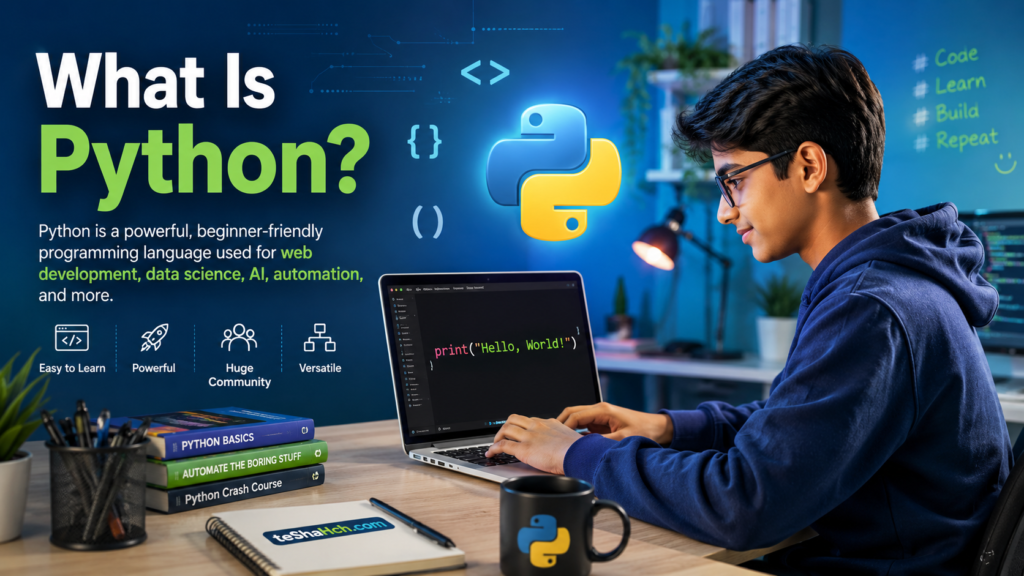
Python is more than just a programming language—it’s a practical skill that helps you solve problems, automate tasks, and create useful applications. Its simple syntax and wide range of uses make it an excellent starting point for anyone interested in coding.
Every experienced programmer once wrote their first print("Hello, World!"). Your journey starts with that same first step. Keep practicing regularly, build small programs, and enjoy the learning process. With consistency, you’ll soon be ready to create your own Python projects.