Discover the best Full Stack Web Development technology stacks in 2026. Compare MERN, MEAN, MEVN, PERN, Django, Laravel, Spring Boot, and ASP.NET Core to choose the right stack for your career.
Full Stack Web Development Technology Stacks Explained: MERN, MEAN, MEVN, PERN & More (Guide)
The demand for Full Stack Developers continues to grow as businesses increasingly rely on web applications, SaaS platforms, e-commerce solutions, and digital services. Whether you’re a beginner planning your development journey or an experienced developer looking to expand your skill set, choosing the right technology stack is one of the most important decisions you’ll make.
With so many options available—MERN, MEAN, MEVN, PERN, Django, Laravel, Spring Boot, and ASP.NET Core—it’s easy to feel overwhelmed.
This comprehensive guide explains the most popular Full Stack Web Development technology stacks in 2026, their advantages, use cases, learning difficulty, career opportunities, and how to choose the best stack for your goals.
What Is Full Stack Web Development?
Full Stack Web Development refers to the process of building both the frontend and backend of a web application.
A Full Stack Developer typically works with:
- Frontend development
- Backend development
- Database management
- APIs and integrations
- Authentication and security
- Deployment and maintenance
In simple terms, a Full Stack Developer can build an entire web application from start to finish.
What Is a Technology Stack?
chnology Stack?
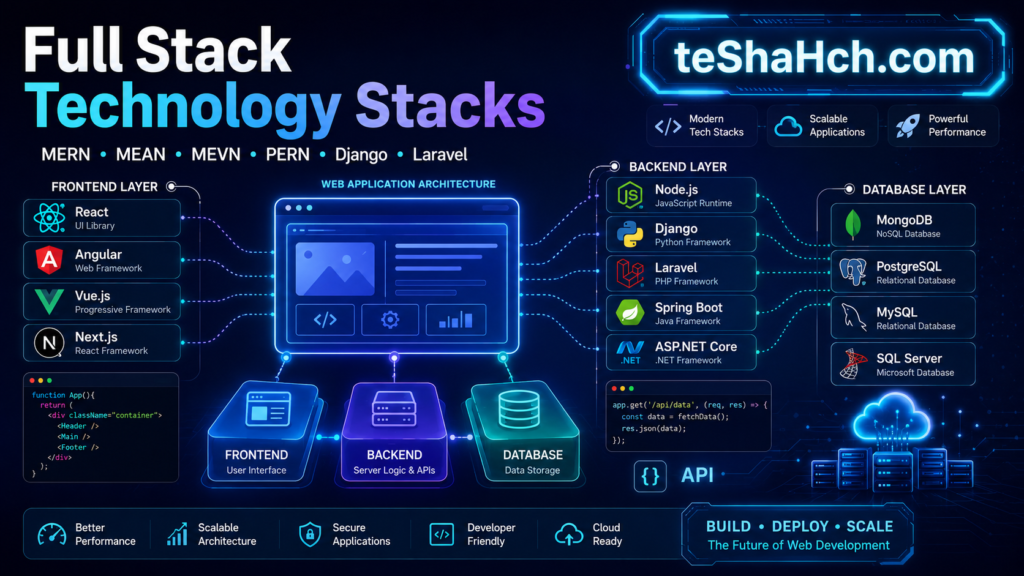
A technology stack is a combination of technologies used to build a complete web application.
Most Full Stack applications consist of three main layers:
Frontend
The part users interact with directly.
Popular frontend technologies include:
- HTML
- CSS
- JavaScript
- React
- Angular
- Vue.js
- Next.js
Backend
The server-side logic that powers the application.
Popular backend technologies include:
- Node.js
- Django
- Laravel
- Spring Boot
- ASP.NET Core
Database
Stores and manages application data.
Popular databases include:
- MongoDB
- PostgreSQL
- MySQL
- SQL Server
MERN Stack
The MERN Stack is one of the most popular JavaScript-based Full Stack development stacks.
MERN Stands For
- MongoDB
- Express.js
- React
- Node.js
Advantages of MERN
- JavaScript across the entire application
- Huge developer community
- Extensive learning resources
- Fast development process
- Ideal for startups and SaaS products
Common Use Cases
- Social media platforms
- SaaS applications
- Admin dashboards
- E-commerce websites
- CRM systems
Who Should Learn MERN?
MERN is ideal for developers who want to build modern web applications using JavaScript from frontend to backend.
MEAN Stack
The MEAN Stack is another JavaScript-based technology stack.
MEAN Stands For
- MongoDB
- Express.js
- Angular
- Node.js
Advantages
- Structured architecture
- Enterprise-friendly
- Excellent for large-scale applications
- Strong TypeScript integration
Challenges
- Angular has a steeper learning curve
- More complex than React for beginners
Best For
- Enterprise software
- Large business applications
- Long-term scalable systems
MEVN Stack
The MEVN Stack replaces React with Vue.js.
MEVN Stands For
- MongoDB
- Express.js
- Vue.js
- Node.js
Advantages
- Easy to learn
- Lightweight framework
- Fast development cycle
- Excellent documentation
Best For
- Small to medium-sized projects
- Startups
- Rapid application development
PERN Stack
The PERN Stack replaces MongoDB with PostgreSQL.
PERN Stands For
- PostgreSQL
- Express.js
- React
- Node.js
Why PERN Is Growing in Popularity
Many modern companies prefer PostgreSQL because of its reliability and powerful relational database capabilities.
Advantages
- Strong data consistency
- Advanced querying capabilities
- Better handling of complex relationships
- Enterprise-ready architecture
Common Use Cases
- Financial applications
- ERP software
- Business management systems
- Data-intensive platforms
Django Stack
Django is one of the most popular Python web frameworks.
Typical Django Stack
- Python
- Django
- PostgreSQL
Advantages
- Rapid development
- Excellent security features
- Scalable architecture
- Built-in admin panel
Ideal For
- Educational platforms
- AI-powered applications
- Data-driven systems
- Enterprise web solutions
Why Developers Choose Django
Developers interested in Artificial Intelligence, Machine Learning, and Data Science often choose Django because it integrates naturally with Python’s ecosystem.
Laravel Stack
Laravel remains one of the most popular PHP frameworks in the world.
Typical Laravel Stack
- PHP
- Laravel
- MySQL
Advantages
- Beginner-friendly
- Large ecosystem
- Easy deployment
- Strong community support
Common Use Cases
- Business websites
- Membership portals
- Content management systems
- Small and medium business software
Spring Boot Stack
Spring Boot is widely used in enterprise software development.
Typical Spring Boot Stack
- Java
- Spring Boot
- PostgreSQL or MySQL
Advantages
- Enterprise-grade security
- High performance
- Excellent scalability
- Strong ecosystem
Common Use Cases
- Banking systems
- Insurance platforms
- Government software
- Large-scale enterprise applications
ASP.NET Core Stack
ASP.NET Core is Microsoft’s modern web development framework.
Typical Stack
- C#
- ASP.NET Core
- SQL Server
Advantages
- Excellent performance
- Enterprise support
- Strong security
- Long-term stability
Common Use Cases
- Corporate software
- Enterprise applications
- Internal business tools
- Large-scale systems
Technology Stack Comparison
| Stack | Learning Difficulty | Job Market | Freelancing | Startup Projects |
|---|---|---|---|---|
| MERN | Easy | High | High | High |
| MEAN | Medium | High | Medium | Medium |
| MEVN | Easy | Medium | Medium | High |
| PERN | Medium | Very High | Medium | High |
| Django | Medium | High | Medium | High |
| Laravel | Easy | Medium | High | Medium |
| Spring Boot | Hard | Very High | Low | High |
| ASP.NET Core | Medium | High | Low | High |
Which Technology Stack Should You Learn?
The best technology stack depends on your goals.
For Beginners
Recommended options:
- MERN Stack
- Laravel Stack
- Django Stack
For Freelancing
Recommended options:
- MERN Stack
- Laravel Stack
- WordPress + PHP
For Startup Development
Recommended options:
- MERN Stack
- PERN Stack
- Next.js + Node.js
For Corporate Jobs
Recommended options:
- Spring Boot
- ASP.NET Core
- Django
- PERN Stack
MERN vs Django: Which Should You Choose?
Choose MERN if:
- You enjoy JavaScript
- You want to become a frontend-focused developer
- You plan to work with React
- You want to build SaaS products
Choose Django if:
- You prefer Python
- You’re interested in AI and Machine Learning
- You want faster backend development
- You plan to work with data-heavy applications
Neither is universally better—the right choice depends on your career goals.
Full Stack Developer Roadmap
If you’re starting from scratch, follow this roadmap:
Step 1: Learn HTML
Understand page structure and semantic markup.
Step 2: Learn CSS
Master layouts, responsive design, and styling.
Step 3: Learn JavaScript
Build interactive user experiences.
Step 4: Learn Git and GitHub
Version control is essential for professional development.
Step 5: Learn a Frontend Framework
Choose React, Angular, Vue, or Next.js.
Step 6: Learn Backend Development
Learn Node.js, Django, Laravel, or another backend technology.
Step 7: Learn Databases
Focus on MongoDB, PostgreSQL, or MySQL.
Step 8: Build Real Projects
Apply your knowledge through practical applications.
Step 9: Learn Deployment
Deploy projects using modern hosting platforms.
Step 10: Create a Portfolio
Showcase your best projects and skills.
Frequently Asked Questions
What is the best Full Stack technology stack in 2026?
There is no single best stack. MERN, PERN, Django, and Next.js-based stacks are among the most popular choices in 2026.
Is MERN still worth learning?
Yes. MERN remains one of the most in-demand technology stacks for startups, SaaS companies, and freelance developers.
How long does it take to become a Full Stack Developer?
With consistent practice, most learners can gain foundational Full Stack development skills within 6–12 months.
Should I learn MongoDB or PostgreSQL?
MongoDB is often easier for beginners, while PostgreSQL is preferred for applications requiring strong data consistency and complex relationships.
Is Full Stack Development a good career?
Yes. Full Stack Development continues to offer strong job opportunities, freelance potential, and career growth worldwide.
Choosing a technology stack is important, but mastering programming fundamentals, problem-solving, software architecture, and real-world project development is even more valuable.
For most developers starting in 2026, learning React, Node.js, and PostgreSQL-based development provides a strong foundation for modern web development careers.
The best approach is simple: choose one stack, build real projects, gain practical experience, and continuously improve your skills. In the long run, your portfolio and problem-solving ability will matter far more than the specific technology stack you started with.