Compare MongoDB and PostgreSQL. Learn the differences, advantages, performance, scalability, career opportunities, and discover which database is best for web development, MERN Stack, freelancing, and jobs.
MongoDB vs PostgreSQL: Which Database Should You Learn
Databases are the backbone of modern web applications. Whether you’re building a social media platform, an e-commerce website, a SaaS product, or an enterprise application, choosing the right database can significantly impact your project’s performance, scalability, and maintainability.
Two of the most popular databases today are MongoDB and PostgreSQL.
If you’re a beginner learning web development or an experienced developer planning your next project, you may wonder:
Should I learn MongoDB or PostgreSQL?
In this comprehensive guide, we’ll compare MongoDB and PostgreSQL, explain their differences, advantages, disadvantages, use cases, performance, scalability, career opportunities, and help you decide which database is right for you.
What Is MongoDB?
MongoDB is a NoSQL document-oriented database.
Instead of storing data in tables and rows, MongoDB stores data in flexible JSON-like documents called BSON (Binary JSON).
Example:
{
  "name": "John Doe",
  "email": "john@example.com",
  "skills": ["JavaScript", "React", "Node.js"]
}
MongoDB is widely used in modern web applications because of its flexibility and ease of development.
What Is PostgreSQL?
PostgreSQL is a powerful open-source relational database management system (RDBMS).
It stores data in structured tables with rows and columns.
Example:
| ID | Name | |
|---|---|---|
| 1 | John Doe | john@example.com |
PostgreSQL follows SQL standards and is known for reliability, performance, and advanced database features.
MongoDB vs PostgreSQL: Quick Comparison
| Feature | MongoDB | PostgreSQL |
|---|---|---|
| Database Type | NoSQL | Relational SQL |
| Data Structure | Documents | Tables |
| Query Language | MongoDB Query Language | SQL |
| Schema | Flexible | Structured |
| Scalability | Excellent | Excellent |
| Complex Relationships | Moderate | Excellent |
| Learning Curve | Easier | Moderate |
| Data Consistency | Good | Excellent |
| Enterprise Applications | Good | Excellent |
| Startup Projects | Excellent | Excellent |
How Data Is Stored
MongoDB
MongoDB stores information in documents.
Example:
{
  "product": "Laptop",
  "price": 1000,
  "brand": "TechBrand"
}
This makes development faster and more flexible.
PostgreSQL
PostgreSQL stores information in tables.
Example:
| Product | Price | Brand |
|---|---|---|
| Laptop | 1000 | TechBrand |
This structure provides strong consistency and relationships.
Ease of Learning
MongoDB
MongoDB is generally easier for beginners.
Why?
✅ Flexible schema
✅ Less database design required
✅ Faster setup
✅ Easier integration with MERN Stack
PostgreSQL
PostgreSQL requires understanding:
- SQL
- Tables
- Relationships
- Normalization
- Database design
Although the learning curve is slightly steeper, these skills are highly valuable in professional software development.
Performance Comparison
Performance depends on your application.
MongoDB Performs Better For
- Rapid prototyping
- Content-heavy applications
- Flexible data structures
- Startup projects
Examples:
- Social media apps
- Blogging platforms
- Real-time dashboards
PostgreSQL Performs Better For
- Complex business applications
- Financial systems
- Enterprise software
- Large-scale relational data
Examples:
- Banking platforms
- ERP systems
- Inventory management software
Scalability
Both databases scale well.
MongoDB
MongoDB was designed with horizontal scaling in mind.
Advantages:
- Sharding support
- Large distributed systems
- Cloud-native architecture
PostgreSQL
PostgreSQL also scales extremely well but typically requires more planning.
Advantages:
- Advanced indexing
- Partitioning
- Query optimization
For most applications, PostgreSQL scalability is more than sufficient.
Data Consistency
This is one of the biggest differences.
MongoDB
MongoDB prioritizes flexibility.
While modern MongoDB versions provide strong consistency options, managing complex relationships can become challenging.
PostgreSQL
PostgreSQL follows ACID principles.
Benefits:
✅ Strong consistency
✅ Reliable transactions
✅ Better data integrity
This is why banks and enterprise companies often prefer PostgreSQL.
Relationships Between Data
MongoDB
MongoDB handles relationships using embedded documents or references.
Works well for:
- User profiles
- Blog posts
- Content management systems
PostgreSQL
PostgreSQL excels at handling relationships.
Examples:
- Customers and Orders
- Students and Courses
- Employees and Departments
Complex relational data is where PostgreSQL truly shines.
MongoDB vs PostgreSQL for Web Development
Choose MongoDB If You Want
- MERN Stack development
- Startup projects
- Fast MVP development
- Flexible data structures
- JavaScript-focused workflows
Common Stack:
MongoDB + Express + React + Node.js
Choose PostgreSQL If You Want
- Enterprise software development
- SaaS applications
- Financial systems
- Complex business logic
- Data consistency
Common Stack:
PostgreSQL + Express + React + Node.js (PERN Stack)
MongoDB vs PostgreSQL for Jobs
Many developers ask:
Which database is better for getting a job?
The answer is:
MongoDB
Popular among:
- Startups
- SaaS companies
- MERN developers
PostgreSQL
Popular among:
- Large companies
- FinTech firms
- Enterprise organizations
- Backend engineering teams
Learning PostgreSQL often provides broader long-term career opportunities.
MongoDB vs PostgreSQL for Freelancing
MongoDB
Advantages:
✅ Faster development
✅ Popular among startup clients
✅ Works well with MERN projects
PostgreSQL
Advantages:
✅ Higher-value business projects
✅ Enterprise clients
✅ Better for complex applications
Freelancers benefit from knowing both databases.
MongoDB vs PostgreSQL for Beginners
If you’re completely new to databases:
Start with MongoDB If:
- You’re learning MERN Stack
- You prefer JavaScript
- You want quicker results
Start with PostgreSQL If:
- You want strong database fundamentals
- You’re interested in backend engineering
- You plan to build business applications
Learning Roadmap
MongoDB Roadmap
- Documents
- Collections
- CRUD Operations
- Queries
- Aggregation
- Indexing
- Authentication
- MongoDB Atlas
PostgreSQL Roadmap
- SQL Basics
- Tables
- Relationships
- Joins
- Indexing
- Transactions
- Query Optimization
- Performance Tuning
Can You Learn Both?
Absolutely.
Many professional developers learn both databases.
A common path is:
Step 1
Learn MongoDB while studying MERN Stack.
Step 2
Learn PostgreSQL when building larger business applications.
This approach provides flexibility and stronger career opportunities.
Frequently Asked Questions (FAQ)
Is MongoDB easier than PostgreSQL?
Yes. MongoDB is generally easier for beginners because of its flexible document-based structure.
Is PostgreSQL better than MongoDB?
Not necessarily. PostgreSQL is better for relational data and enterprise applications, while MongoDB is excellent for flexible and rapidly changing applications.
Should I learn MongoDB or PostgreSQL first?
If you’re learning MERN Stack, start with MongoDB. If you’re focused on backend engineering and enterprise software, PostgreSQL may be the better first choice.
Do companies use MongoDB?
Yes. Many startups and SaaS companies use MongoDB for modern web applications.
Is PostgreSQL in demand?
Absolutely. PostgreSQL is one of the most respected and widely used databases in the software industry.
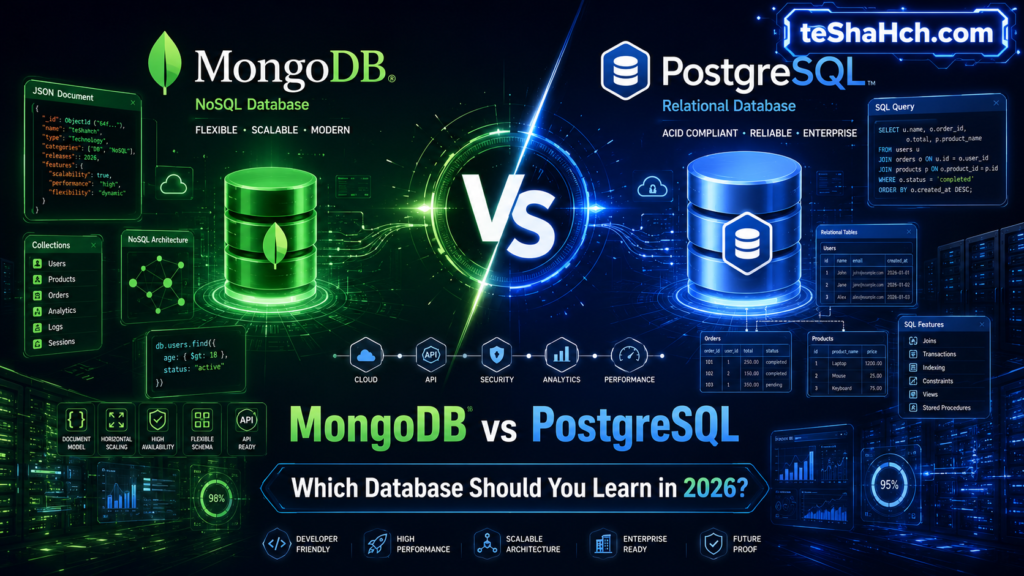
Both MongoDB and PostgreSQL are excellent databases, and neither is universally better than the other.
Choose MongoDB if you want flexibility, rapid development, and MERN Stack integration.
Choose PostgreSQL if you need strong relationships, data consistency, and enterprise-grade capabilities.
For most aspiring Full Stack Developers in 2026, the ideal path is to learn both. Start with the database that aligns with your current learning goals, then expand your skills as you grow.
The more important question isn’t which database is better—it’s which database is better for the type of applications you want to build.