Learn CRUD Operations from scratch with this complete beginner’s guide. Understand Create, Read, Update, Delete, HTTP methods, REST APIs, databases, Express.js, MongoDB, PostgreSQL, and best practices for modern web development.
CRUD Operations Explained for Beginners: Complete Guide to Create, Read, Update & Delete
Every modern application stores, retrieves, updates, and deletes data.
Whether you’re using Facebook, Amazon, WhatsApp, a banking app, or a school management system, the same four fundamental operations happen behind the scenes.
These operations are known as CRUD.
CRUD is one of the most important concepts in backend development because almost every web application, mobile application, and enterprise software depends on it.
If you’ve already learned REST APIs, Express.js, and Node.js, then understanding CRUD Operations is the next logical step toward becoming a professional backend or full-stack developer.
In this comprehensive guide, you’ll learn what CRUD means, why it’s important, how it works with databases and REST APIs, and how developers use CRUD to build modern applications.
What Are CRUD Operations?
CRUD is an acronym that represents the four basic operations performed on data.
- Create
- Read
- Update
- Delete
Every database-driven application performs these operations repeatedly.
Imagine a student management system.
You can:
- Add a new student.
- View student information.
- Update student details.
- Remove a student.
These four actions represent CRUD.
Breaking Down CRUD
Let’s understand each operation individually.
Create
Create means adding new data to the database.
Examples:
- Register a new user
- Add a new product
- Publish a blog post
- Place an order
- Create a support ticket
Whenever new information is stored, a Create operation occurs.
Read
Read means retrieving existing information.
Examples:
- View your profile
- Display products
- Search for books
- Load dashboard statistics
- View blog articles
Most user interactions involve Read operations.
Update
Update means modifying existing information.
Examples:
- Change your password
- Edit your profile
- Update product prices
- Modify order details
- Change employee information
Applications constantly update stored data.
Delete
Delete removes data from the database.
Examples:
- Delete an account
- Remove a comment
- Delete a product
- Cancel an order
- Remove a task
Delete operations permanently remove information unless soft-delete techniques are used.
Why Are CRUD Operations Important?
CRUD is the foundation of nearly every software application.
Without CRUD, applications would be unable to store or manage information.
Consider an online shopping platform.
Users can:
- Create an account.
- Browse products.
- Update their shopping cart.
- Delete unwanted items.
Every feature ultimately relies on CRUD.
CRUD in Everyday Applications
You use CRUD operations more often than you might realize.
Social Media
Create:
- Publish posts
Read:
- View feeds
Update:
- Edit captions
Delete:
- Remove posts
Banking Applications
Create:
- Open an account
Read:
- Check balances
Update:
- Change personal information
Delete:
- Remove beneficiaries
E-commerce
Create:
- Add products
Read:
- Browse catalog
Update:
- Edit cart
Delete:
- Remove items
Hospital Management
Create:
- Register patients
Read:
- View medical history
Update:
- Modify prescriptions
Delete:
- Remove duplicate records
School Management
Create:
- Add students
Read:
- View attendance
Update:
- Edit grades
Delete:
- Remove old records
CRUD powers almost every digital service we use.
Understanding the CRUD Workflow
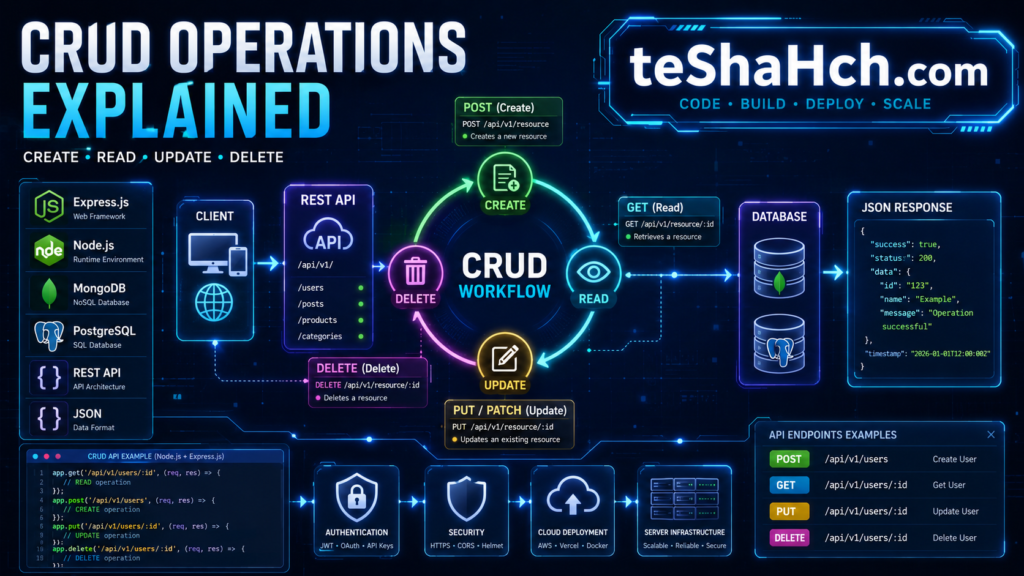
CRUD operations follow a structured workflow.
A simplified architecture looks like this:
Client
   │
   ▼
REST API
   │
   ▼
Business Logic
   │
   ▼
Database
   │
   ▼
JSON Response
Here’s what happens:
- The client sends a request.
- The REST API receives it.
- Business logic processes the request.
- The database performs the CRUD operation.
- A response is returned to the client.
This workflow forms the backbone of modern backend applications.
CRUD and Databases
CRUD operations are impossible without a database.
A database stores and manages application data.
Popular databases include:
NoSQL
- MongoDB
- Firebase
SQL
- PostgreSQL
- MySQL
- MariaDB
- SQL Server
- SQLite
Regardless of the database type, CRUD operations remain the same.
CRUD in REST APIs
REST APIs map CRUD operations to HTTP methods.
| CRUD Operation | HTTP Method |
|---|---|
| Create | POST |
| Read | GET |
| Update | PUT / PATCH |
| Delete | DELETE |
For example:
Create a user
POST /usersRetrieve all users
GET /usersUpdate user information
PUT /users/5Delete a user
DELETE /users/5This mapping is one of the reasons REST APIs are easy to understand and widely adopted.
CRUD and HTTP Methods
Let’s see how HTTP methods correspond to CRUD.
POST → Create
Adds new data.
Examples:
- Register user
- Add product
- Publish article
GET → Read
Retrieves information.
Examples:
- View products
- View users
- Load orders
PUT / PATCH → Update
Modifies existing data.
Examples:
- Edit profile
- Update inventory
- Change password
DELETE → Delete
Removes existing data.
Examples:
- Delete comments
- Remove products
- Delete accounts
Understanding this relationship is essential for backend development.
CRUD Example: Online Bookstore
Imagine you’re building an online bookstore.
Create
Add a new book.
Read
Display all books.
Update
Change the book price.
Delete
Remove an unavailable book.
The same four operations repeat throughout the application.
CRUD Example: Task Manager
A simple to-do application performs CRUD continuously.
Create:
- Add a new task.
Read:
- Display tasks.
Update:
- Mark a task as completed.
Delete:
- Remove finished tasks.
This simple example demonstrates why CRUD is fundamental to software development.
CRUD Example: Student Management System
Consider a school management application.
Teachers can:
Create:
- Register students.
Read:
- View student records.
Update:
- Modify grades.
Delete:
- Remove graduated students.
Nearly every educational platform follows this pattern.
Why Every Full Stack Developer Should Learn CRUD
CRUD is one of the first backend concepts every developer should master.
It enables you to:
- Build REST APIs.
- Connect databases.
- Manage application data.
- Develop scalable web applications.
- Build real-world projects.
- Understand backend architecture.
Whether you’re building a MERN Stack application, an e-commerce platform, or a SaaS product, CRUD operations are used every day.
Mastering CRUD is an essential milestone in becoming a professional web developer.
CRUD with Express.js
Express.js is one of the most popular backend frameworks for building CRUD applications.
It simplifies server creation, routing, request handling, and response management, making CRUD development fast and organized.
A typical Express.js CRUD workflow looks like this:
Client
   │
   ▼
Express.js Server
   │
   ▼
Routes
   │
   ▼
Controllers
   │
   ▼
Database
   │
   ▼
JSON Response
Each request passes through routes and controllers before interacting with the database.
CRUD with MongoDB
MongoDB is one of the most popular NoSQL databases used in MERN Stack applications.
Every CRUD operation corresponds to a database action.
Create
Insert a new document.
Example:
- Register a user
- Add a product
- Publish a blog post
Read
Retrieve one or multiple documents.
Examples:
- Display all products
- View user profiles
- Load blog posts
Update
Modify existing documents.
Examples:
- Change email
- Update inventory
- Edit product price
Delete
Remove documents.
Examples:
- Delete user
- Remove product
- Delete comment
MongoDB stores information as flexible JSON-like documents, making CRUD operations intuitive and efficient.
CRUD with PostgreSQL
PostgreSQL follows the same CRUD principles but stores data in relational tables.
Examples include:
Create
Insert a new employee.
Read
Retrieve employee records.
Update
Modify employee salary.
Delete
Remove inactive employees.
Whether you’re using MongoDB or PostgreSQL, the CRUD concepts remain the same. Only the database structure differs.
CRUD Architecture
Professional CRUD applications are usually organized into multiple layers.
A simplified architecture looks like this:
Frontend
      │
      ▼
REST API
      │
      ▼
Routes
      │
      ▼
Controllers
      │
      ▼
Business Logic
      │
      ▼
Database
      │
      ▼
JSON Response
This layered approach improves maintainability, scalability, and code organization.
CRUD Request Flow
Let’s understand what happens when a user updates a profile.
Step 1
The frontend sends a request.
↓
Step 2
Express receives the request.
↓
Step 3
The correct route is identified.
↓
Step 4
The controller validates the data.
↓
Step 5
The database updates the record.
↓
Step 6
A JSON response is returned.
This same workflow applies to Create, Read, Update, and Delete operations.
CRUD and HTTP Methods
Every CRUD action maps to a standard HTTP method.
| CRUD | HTTP Method | Purpose |
|---|---|---|
| Create | POST | Insert new data |
| Read | GET | Retrieve data |
| Update | PUT / PATCH | Modify data |
| Delete | DELETE | Remove data |
This mapping is one of the reasons REST APIs are easy to understand and maintain.
CRUD Best Practices
Professional developers follow best practices to build reliable CRUD applications.
1. Validate Input Data
Never trust user input.
Validate:
- Email addresses
- Passwords
- Required fields
- Numeric values
- Dates
Input validation improves both security and data quality.
2. Return Meaningful Responses
API responses should clearly indicate success or failure.
Example response:
{
  "success": true,
  "message": "Product created successfully",
  "data": {
    "id": 101,
    "name": "Laptop"
  }
}
Consistent response formats simplify frontend development.
3. Use Proper HTTP Status Codes
Examples:
- 200 OK
- 201 Created
- 400 Bad Request
- 401 Unauthorized
- 404 Not Found
- 500 Internal Server Error
Correct status codes improve API usability and debugging.
4. Handle Errors Gracefully
Instead of crashing the application:
- Catch exceptions
- Return meaningful messages
- Log server errors
Reliable error handling creates better user experiences.
5. Separate Application Layers
Avoid writing everything in one file.
Use separate folders for:
- Routes
- Controllers
- Models
- Middleware
- Configuration
This keeps projects clean and scalable.
6. Secure CRUD Operations
Protect sensitive endpoints using:
- Authentication
- Authorization
- Input validation
- HTTPS
- Rate limiting
Security should always be considered from the beginning.
Common Beginner Mistakes
Many beginners encounter the same issues while building CRUD applications.
1. Mixing Business Logic with Routes
Routes should delegate work to controllers instead of containing all application logic.
2. Ignoring Validation
Invalid data can corrupt databases and cause application errors.
3. Returning Incorrect Status Codes
Returning 200 OK for every response makes debugging difficult.
4. Not Handling Database Errors
Always anticipate:
- Connection failures
- Duplicate entries
- Missing records
- Validation errors
5. Skipping Authentication
Sensitive CRUD operations should never be publicly accessible.
6. Testing Too Little
Every CRUD endpoint should be tested thoroughly before deployment.
Advantages of CRUD
CRUD remains the foundation of backend development because of its many benefits.
Simple Concept
Easy for beginners to understand.
Universal
Works with SQL and NoSQL databases.
Standardized
Most backend frameworks follow CRUD principles.
Scalable
Suitable for both small and enterprise applications.
Easy API Design
REST APIs naturally map CRUD operations to HTTP methods.
Highly Reusable
Once learned, CRUD concepts apply across different programming languages and frameworks.
Disadvantages of CRUD
Although CRUD is fundamental, developers should be aware of its limitations.
Limited Business Logic
CRUD alone cannot represent complex workflows.
Security Challenges
Poorly secured CRUD endpoints may expose sensitive data.
Complex Enterprise Systems
Large applications often require additional architectural patterns beyond basic CRUD.
Performance Considerations
Large datasets require pagination, indexing, and optimized queries to maintain performance.
Real-World CRUD Projects
Hands-on projects are the best way to reinforce CRUD concepts.
Beginner Projects
- Notes API
- To-Do List
- Student Record System
- Contact Management
- Book Library
Intermediate Projects
- Blog Management System
- Inventory Management
- Employee Management
- Expense Tracker
- Event Management
Advanced Projects
- E-commerce Backend
- Learning Management System
- CRM Platform
- Hospital Management System
- SaaS Dashboard
Building these projects helps transform theoretical knowledge into practical skills.
CRUD Learning Roadmap
A structured roadmap for mastering CRUD:
Step 1
Learn HTTP fundamentals.
Step 2
Understand REST APIs.
Step 3
Learn Express.js.
Step 4
Understand databases.
Choose one:
- MongoDB
- PostgreSQL
Step 5
Build simple CRUD APIs.
Step 6
Add validation and authentication.
Step 7
Deploy your application.
Step 8
Build real-world projects.
Consistent practice and project building are the fastest ways to master CRUD development.
Is Learning CRUD Operations Worth It?
Absolutely.
CRUD Operations are the foundation of almost every modern software application. Whether you’re building a simple blog, an e-commerce platform, a banking application, or an enterprise management system, CRUD is involved in nearly every feature.
Without understanding CRUD, it’s impossible to build complete backend applications or connect a frontend to a database effectively.
If you’re following a Full Stack Developer Roadmap, learning CRUD after REST API is one of the most important milestones in your journey.
Why CRUD Is Still Essential
CRUD remains one of the most valuable concepts in software development because it is:
✅ Used in almost every web application
✅ Database-independent
✅ Framework-independent
✅ Easy to understand
✅ Essential for REST API development
✅ Required in Full Stack Development
✅ Frequently asked in technical interviews
No matter which backend technology you choose—Node.js, Django, Laravel, Spring Boot, ASP.NET Core, or Go—you’ll use CRUD every day.
Career Opportunities
Developers who understand CRUD operations have a strong foundation for backend and full-stack roles.
Common Job Roles
- Backend Developer
- Full Stack Developer
- Node.js Developer
- MERN Stack Developer
- API Developer
- Software Engineer
- Web Application Developer
- Database Developer (Entry Level)
Industries Using CRUD Applications
Almost every industry relies on CRUD-based software:
- Software Companies
- SaaS Platforms
- E-commerce
- FinTech
- Healthcare
- Education Technology
- Banking
- Government Services
- Logistics
- Enterprise IT
CRUD knowledge is transferable across industries because data management is universal.
Best Resources to Learn CRUD Operations
The best way to master CRUD is through practice.
1. Build Small Projects
Start with simple applications such as:
- Notes App
- To-Do List
- Student Management System
- Contact Book
- Library Management
2. Learn Through REST APIs
Implement CRUD endpoints using Express.js or another backend framework.
You’ll gain experience with:
- Routing
- HTTP Methods
- Database Operations
- JSON Responses
3. Practice with Databases
Experiment with both:
- MongoDB (NoSQL)
- PostgreSQL (SQL)
Understanding CRUD in both environments makes you a more versatile developer.
4. Read Open-Source Projects
Explore GitHub repositories to learn how experienced developers organize CRUD applications using routes, controllers, models, and middleware.
5. Build Complete Applications
Once comfortable with basic CRUD, create larger projects:
- Inventory Management System
- Blog Platform
- Expense Tracker
- CRM Dashboard
- E-commerce Backend
Real-world projects strengthen both your skills and portfolio.
CRUD Learning Timeline
A realistic learning plan for beginners:
| Stage | Estimated Time |
|---|---|
| HTTP Basics | 3–5 Days |
| REST API Fundamentals | 1 Week |
| CRUD Concepts | 3–5 Days |
| Express.js CRUD | 1–2 Weeks |
| Database Integration | 2 Weeks |
| Authentication | 1–2 Weeks |
| Deployment | 1 Week |
| Real Projects | Ongoing |
Remember: practical implementation is more important than memorizing theory.
Frequently Asked Questions (FAQ)
What does CRUD stand for?
CRUD stands for:
- Create
- Read
- Update
- Delete
These are the four fundamental operations used to manage data.
Why are CRUD operations important?
CRUD operations allow applications to create, retrieve, modify, and remove data. They form the backbone of database-driven software.
Are CRUD operations only used in web development?
No.
CRUD is used in:
- Web applications
- Mobile apps
- Desktop software
- Enterprise systems
- Cloud applications
- APIs
- Database management systems
Can CRUD be used with SQL and NoSQL databases?
Yes.
CRUD concepts work with both relational and non-relational databases.
Examples include:
- MongoDB
- PostgreSQL
- MySQL
- MariaDB
- SQL Server
- SQLite
Which HTTP methods correspond to CRUD?
| CRUD Operation | HTTP Method |
|---|---|
| Create | POST |
| Read | GET |
| Update | PUT / PATCH |
| Delete | DELETE |
This mapping is standard in RESTful API development.
What should I learn after CRUD?
A recommended next learning path is:
- HTTP Methods
- HTTP Status Codes
- JSON
- Authentication
- JWT
- MongoDB
- PostgreSQL
- API Security
- Docker
These topics build naturally on your CRUD knowledge.
Is CRUD enough to become a backend developer?
CRUD is a strong starting point, but you’ll also need to learn:
- REST APIs
- Authentication
- Databases
- Security
- Deployment
- Testing
- Version Control (Git)
Together, these skills prepare you for real-world backend development.
CRUD Operations are much more than a programming concept—they are the foundation of how applications manage information.
From social media platforms and banking systems to online stores and healthcare applications, CRUD powers the creation, retrieval, modification, and deletion of data behind the scenes.
By mastering CRUD, you’ll gain a deeper understanding of backend development, database interactions, and RESTful APIs. These skills are essential for building scalable, maintainable, and production-ready software.
If you’re following a structured Full Stack roadmap, learning CRUD after REST APIs creates a strong bridge to more advanced topics such as authentication, database design, API security, and cloud deployment.
The best way to become proficient is to build real applications, experiment with different databases, and continuously improve your code through practice and feedback.