Want to become a Full Stack Developer? Follow this step-by-step roadmap covering HTML, CSS, JavaScript, React, Node.js, databases, deployment, and real-world projects.
Full Stack Developer Roadmap : A Complete Beginner Guide
Web Development remains one of the most in-demand skills in the technology industry. Companies, startups, and businesses worldwide are constantly looking for developers who can build complete web applications from frontend to backend.
If you’re wondering how to become a Full Stack Developer, you’re in the right place.
This roadmap will guide you through the exact technologies, skills, and learning path needed to become a professional Full Stack Developer.
Whether you’re a student, freelancer, career switcher, or aspiring software engineer, this guide will help you build a clear roadmap for success.
What Is a Full Stack Developer?
A Full Stack Developer is someone who can work on both the frontend and backend of a web application.
A Full Stack Developer typically handles:
- Frontend Development
- Backend Development
- Database Management
- APIs
- Authentication
- Deployment
- Application Maintenance
In simple terms, Full Stack Developers can build an entire web application from scratch.
Why Learn Full Stack Development?
The demand for Full Stack Developers continues to grow because businesses prefer developers who understand multiple parts of an application.
Benefits of Becoming a Full Stack Developer
✅ High demand in the job market
✅ Freelancing opportunities
✅ Startup-friendly skillset
✅ Higher salary potential
✅ Ability to build complete products independently
Best Full Stack Web Development Technology Stacks : MERN, MEAN, MEVN, PERN & More
Step 1: Learn HTML
HTML (HyperText Markup Language) is the foundation of every website.
Before learning advanced technologies, you must understand how web pages are structured.
Topics to Learn
- HTML Elements
- Semantic HTML
- Forms
- Tables
- Images
- Audio & Video
- Accessibility Basics
Practice Projects
- Personal Portfolio
- Landing Page
- Blog Layout
- Company Website Homepage
Step 2: Learn CSS
CSS controls how websites look and feel.
A well-designed website depends heavily on CSS skills.
Topics to Learn
- Selectors
- Box Model
- Flexbox
- CSS Grid
- Responsive Design
- Media Queries
- Animations
Modern CSS Tools
- Tailwind CSS
- Bootstrap
Practice Projects
- Responsive Portfolio
- Pricing Page
- Product Landing Page
- Dashboard UI
Step 3: Master JavaScript
JavaScript is the most important programming language for modern web development.
It powers interactive websites and web applications.
Topics to Learn
Fundamentals
- Variables
- Data Types
- Functions
- Arrays
- Objects
- Loops
- Conditions
Intermediate Concepts
- DOM Manipulation
- Event Handling
- Fetch API
- Local Storage
Advanced Concepts
- ES6+
- Async/Await
- Promises
- Modules
- Closures
- Error Handling
Practice Projects
- To-Do App
- Weather App
- Calculator
- Quiz Application
Step 4: Learn Git and GitHub
Version control is an essential skill for every developer.
Learn
- Git Basics
- Repositories
- Branches
- Merging
- Pull Requests
- Collaboration Workflow
Why It Matters
Most companies use GitHub or similar platforms for project management and code collaboration.
Step 5: Learn React
React is currently one of the most popular frontend libraries.
Many modern applications use React for building dynamic user interfaces.
Topics to Learn
- Components
- Props
- State
- Hooks
- Routing
- Forms
- API Integration
React Ecosystem
- React Router
- Context API
- Redux Toolkit
Projects
- E-commerce Frontend
- Movie Search App
- Admin Dashboard
- Social Media UI
Step 6: Learn Backend Development with Node.js
After mastering frontend development, it’s time to learn backend development.
Node.js allows JavaScript to run on the server.
Topics to Learn
- Node.js Basics
- File System
- REST APIs
- Authentication
- Middleware
- Error Handling
Learn Express.js
Express.js simplifies backend development.
Build
- Authentication API
- Blog Backend
- Task Manager API
- User Management System
Step 7: Learn Databases
Every modern application needs a database.
The two most popular choices are MongoDB and PostgreSQL.
MongoDB
A NoSQL database.
Best For
- Startups
- Rapid Development
- Flexible Data Structures
PostgreSQL
A relational database.
Best For
- Business Applications
- Financial Systems
- Enterprise Software
Database Concepts
Learn:
- CRUD Operations
- Relationships
- Indexing
- Query Optimization
- Database Security
Step 8: Learn Authentication and Security
Security is critical in modern applications.
Topics
- JWT Authentication
- OAuth
- Password Hashing
- Session Management
- Role-Based Access Control
Security Best Practices
- HTTPS
- Environment Variables
- Input Validation
- API Protection
Step 9: Learn APIs
APIs connect different parts of an application.
Learn
- REST API
- JSON
- API Testing
- API Documentation
Tools
- Postman
- Insomnia
Projects
- Weather API
- Blog API
- E-commerce API
Step 10: Learn Deployment
Building an application is only half the job.
You must know how to deploy it online.
Frontend Deployment
- Vercel
- Netlify
Backend Deployment
- Railway
- Render
Database Hosting
- MongoDB Atlas
- Supabase
- Neon
Topics to Learn
- Environment Variables
- CI/CD Basics
- Domain Configuration
- SSL Certificates
Step 11: Build Real-World Projects
Projects are more important than certificates.
Build projects that demonstrate your skills.
Beginner Projects
- Portfolio Website
- To-Do App
- Blog Website
Intermediate Projects
- Expense Tracker
- E-commerce Website
- Chat Application
Advanced Projects
- SaaS Dashboard
- Learning Management System
- CRM Software
- Project Management Tool
Step 12: Create a Strong Portfolio
A portfolio helps employers and clients evaluate your skills.
Include:
- About Me
- Skills
- Projects
- GitHub Profile
- Contact Information
Step 13: Prepare for Jobs and Freelancing
Once you have projects and a portfolio, start applying.
For Jobs
Focus on:
- Data Structures
- Problem Solving
- System Design Basics
- Technical Interviews
For Freelancing
Focus on:
- Communication
- Client Management
- Project Estimation
- Proposal Writing
Recommended Full Stack Learning Path
HTML
↓
CSS
↓
JavaScript
↓
Git & GitHub
↓
React
↓
Node.js
↓
Express.js
↓
MongoDB/PostgreSQL
↓
Authentication
↓
APIs
↓
Deployment
↓
Real Projects
↓
Portfolio
↓
Job/Freelancing
Common Mistakes Beginners Make
1. Tutorial Hell
Watching endless tutorials without building projects.
2. Learning Too Many Technologies
Master one stack before jumping to another.
3. Ignoring Fundamentals
Strong HTML, CSS, and JavaScript skills are essential.
4. Not Building Projects
Projects create real experience.
5. Avoiding Deployment
A deployed project is far more valuable than a local project.
Frequently Asked Questions
How long does it take to become a Full Stack Developer?
Most learners can become job-ready within 6–12 months with consistent practice.
Should I learn MERN or Django?
If you enjoy JavaScript, start with MERN. If you prefer Python or AI-related development, Django is a great choice.
Do I need a Computer Science degree?
No. Many successful Full Stack Developers are self-taught.
Is Full Stack Development a good career in 2026?
Yes. Full Stack Development remains one of the most valuable and in-demand technology careers worldwide.
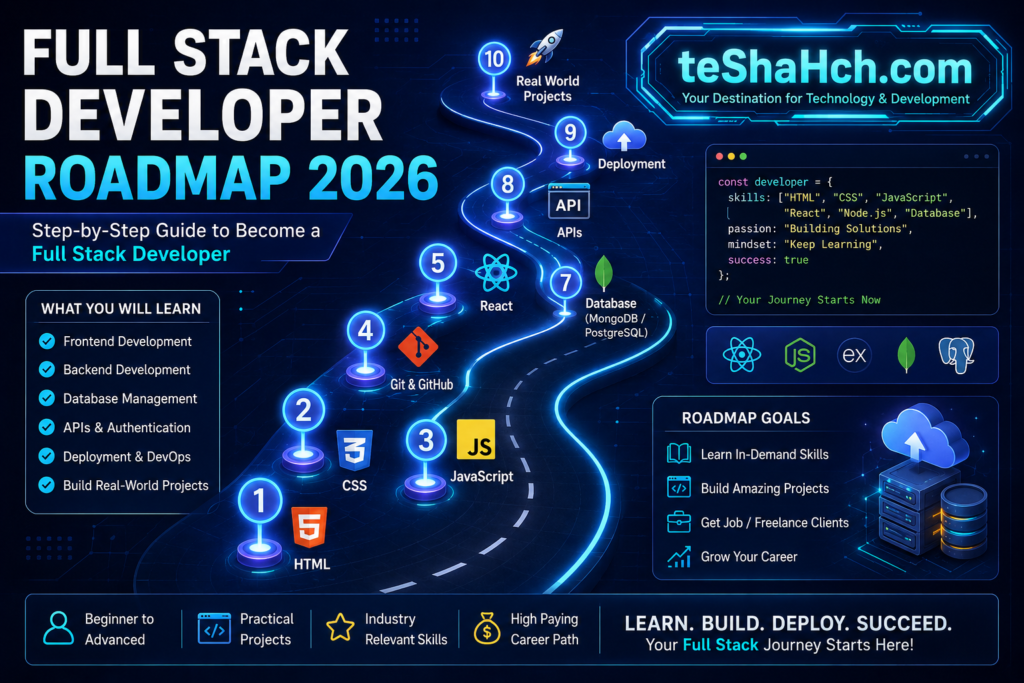
The journey to becoming a Full Stack Developer may seem overwhelming at first, but it becomes much easier when you follow a structured roadmap.
Focus on mastering the fundamentals first: HTML, CSS, and JavaScript. Then move to React, Node.js, databases, deployment, and real-world projects.
Remember, companies hire developers who can solve problems and build products—not developers who simply complete courses.
Choose a technology stack, stay consistent, build projects, and keep learning. By following this Full Stack Developer Roadmap, you’ll be well-positioned for a successful web development career in 2026 and beyond.